In this article
The iPhone Duo review from TechCrunch reporter Sarah Perez found that Apple’s foldable won her over during a five-day vacation, despite repeated frustrations with software, Touch ID and the camera. Perez carried the Duo alongside an iPhone 17 Pro Max as a backup, but by the end of the trip she preferred the newer foldable for everyday use.
Key Takeaways
- Sarah Perez used the iPhone Duo more than her iPhone 17 Pro Max during a five-day vacation.
- The Duo lacks Face ID and has fewer camera capabilities than the iPhone 17 Pro Max.
- Unoptimized apps and repeated Google Search freezes caused software frustrations during the trip.
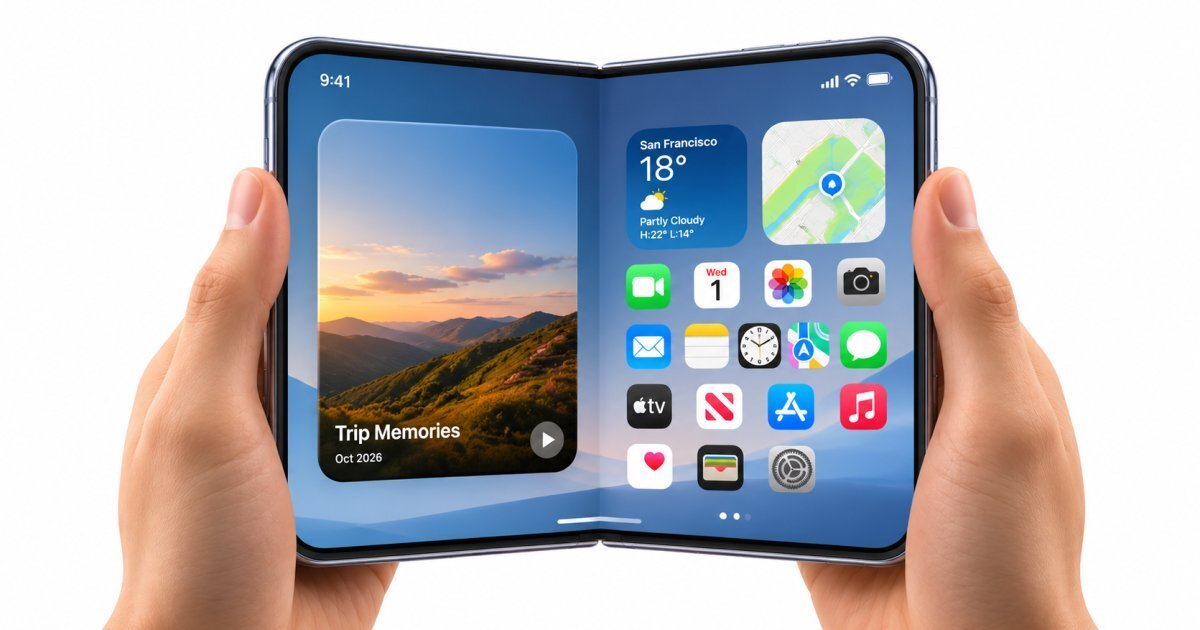
That outcome from the iPhone Duo review matters because the Duo asks buyers to accept several compromises for a roughly $2,000 phone. It has a compact outer screen, a larger unfolded display and Apple’s software ecosystem. It also lacks Face ID, offers fewer camera capabilities than the iPhone 17 Pro Max and still encounters apps that were not designed for its format. Perez’s account of the vacation shows how those trade-offs feel in ordinary use.
How the iPhone Duo handled a five-day trip
Perez received the Duo from Apple as a loaner shortly before leaving for vacation. Coming from the iPhone 17 Pro Max, she initially found its short, squat shape unfamiliar and worried about losing the larger phone’s screen space. She brought the Pro Max as a safety net, yet used the Duo more often as the trip continued.
The iPhone Duo review’s travel test also proved less awkward to carry than she expected. Perez said it fit in both front and back pockets, even with a case. She repeatedly sat on it in a back pocket and accidentally dropped it at least three times onto concrete, tile and wood. The phone did not break or develop a cracked screen. She emphasized that these were not professional durability tests, so her experience should not be treated as a formal drop-test result.
That pocket comfort made the hardware easier to live with. The iPhone Duo review makes the foldable design’s useful distinction clear: closed, the Duo behaves like a smaller phone; open, it provides a larger workspace for video and multitasking.
Why the iPhone Duo review keeps returning to software
The compact outer display introduced practical annoyances. Perez had to scroll more when reading long text threads, while some apps placed important controls inside a three-dot “more” menu. Several apps also showed a black bar when the phone was closed because they had not yet been updated for the Duo’s screen.
According to Perez, those unoptimized apps were visually awkward but generally usable. Google Maps, for example, still worked for driving directions, local searches, discovery and route planning even though it was not optimized during the trip. She also observed that companies were releasing Duo updates quickly, although some apps remained unchanged.
In the iPhone Duo review, the more serious problem involved Google’s Search app. Perez said it froze multiple times, particularly when she was using its AI Mode, which can appear without being deliberately selected. She relied on Search for restaurant reviews, weather, points of interest and distances between towns, so the problem became her biggest software frustration. Force-closing the app and reopening it was the reported workaround.
The experience shows why an Apple foldable smartphone depends on more than its hinge and screens. The Duo’s usefulness also depends on developers adapting apps to the new layout, and the source does not establish that every major or older app has been updated.
Newsletter
Get the VaidikX AI Brief
The week's biggest AI, Big Tech and startup news, explained in 5 minutes. Free, every week.
Touch ID and the iPhone Duo camera are major compromises
For Perez, the absence of Face ID was the Duo’s biggest drawback. The phone returns to Touch ID, which requires placing a finger or thumb on the sensor to authenticate. An Apple Watch helped her avoid Touch ID when unlocking the device, but that alternative did not remove the friction from in-app authentication or Apple Pay.
Payment was especially inconvenient while she was carrying shopping bags, a purse and a dog leash. Perez said she often failed to keep her finger on the sensor long enough or had to adjust its position. She eventually became more accustomed to the process, but described the change as a significant reason some potential buyers may hesitate. The source mentions that a future version is said to support Face ID, but does not confirm when that might happen.
The iPhone Duo review’s camera comparison is another clear step down from the iPhone 17 Pro Max. The Duo has two rear cameras compared with three on the Pro Max, lacks a telephoto lens, offers 10x digital zoom rather than the Pro’s 40x and does not include the Pro’s more advanced low-light hardware. The Pro Max also supports ProRAW and ProRes, features the Duo does not have according to the source.
Perez’s view was that serious iPhone photographers and content creators should not choose the Duo as their primary device. For ordinary snapshots shared through social networks or messages, she considered the camera acceptable, though she noticed processing that could make fine details look overdone and distant landscapes appear flat or smoothed.
The foldable screen changes how the phone is used
The main reason to choose the Duo is its foldable form. Perez praised the barely visible crease, the consistent aspect ratio between the outer and inner screens and the way content scales between them. She also liked using the larger display for watching movies, particularly with the Duo Folio case and its kickstand.
The iPhone Duo review also shows that she did not unfold the phone as often as expected. Opening it in public attracted attention and sometimes led to conversations with strangers. Several people were surprised by the screen and hinge, while one person was especially interested in Kid Cue, a feature that shows Snoopy animations on the outer display to encourage children to look toward the camera.
When Perez did unfold the Duo, the activity usually had a clear purpose. She used the larger screen for Netflix and split-screen multitasking, such as reading news in Inoreader while keeping X open beside it. Split-screen mode can be activated by swiping up from the bottom and dragging an app to the left or right edge; on-screen target boxes show where it will be placed.
This design also affected her behavior. Perez felt less drawn to time-consuming apps such as TikTok, Instagram and casual games when the phone was closed. In her interpretation, the extra step of opening the device made smartphone use more intentional: the Duo was appealing to pick up for a specific task, but easier to put down afterward.
What Perez’s iPhone Duo review says about the trade-off
The iPhone Duo review is ultimately positive, but it is not a claim that the foldable is superior in every category. The Pro Max remains the stronger choice for people who prioritize camera hardware, zoom, professional photo and video formats or the convenience of Face ID. The Duo asks those users to trade established features for a different physical design and a larger display when unfolded.
Durability was reassuring during Perez’s trip, including accidental drops and repeated pressure from a back pocket. The Duo is rated IP68, with the source explaining that the “6” indicates high dust resistance. However, Perez did not test it at a beach, and the article leaves open how the hinge would handle sand in real travel conditions.
For Perez, the iPhone Duo review’s appeal was less about eliminating every compromise than about changing her relationship with the phone. Apple’s foldable made video, multitasking and some apps more engaging while adding friction to casual scrolling. After carrying two iPhones to avoid being stranded with the wrong choice, she finished the vacation wanting the Duo rather than returning to the familiar Pro Max.
Source: Yahoo Tech
More from VaidikX