In this article
- What the Microsoft $25 billion bond sale and buyout offer mean
- Why Microsoft is borrowing while holding substantial cash
- AI infrastructure spending is pushing capital needs higher
- Azure demand is keeping the pressure on
- Why investor demand matters, and what it does not prove
- What the workforce decision does and does not say
- What to watch next
The Microsoft $25 billion bond sale gives the company another source of funding as it expands AI infrastructure and cloud capacity. It came days after Microsoft offered voluntary buyouts to about 60,000 eligible employees. Microsoft has not said the borrowed money will pay for employee departures, so the two announcements should be treated as separate decisions.
Key Takeaways
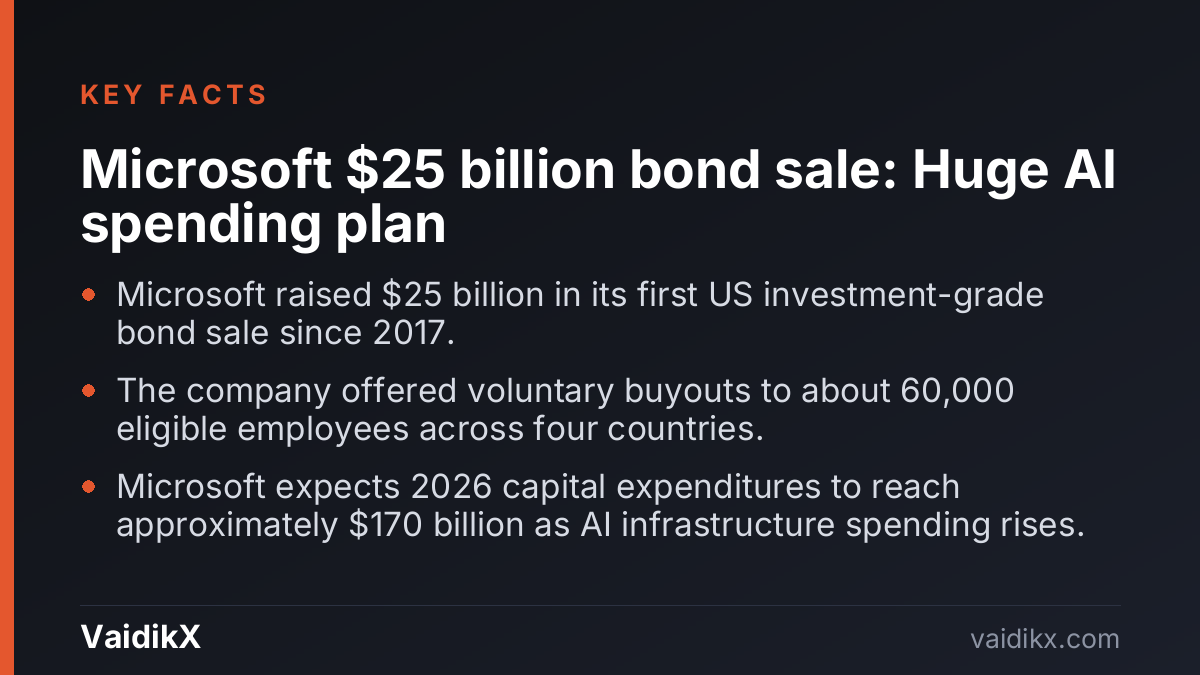
- Microsoft raised $25 billion in its first US investment-grade bond sale since 2017.
- The company offered voluntary buyouts to about 60,000 eligible employees across four countries.
- Microsoft expects 2026 capital expenditures to reach approximately $170 billion as AI infrastructure spending rises.
The timing still raises a broader question: why is a company with substantial cash flow borrowing as it increases spending on computing capacity while reviewing its workforce structure? The reported bond transaction and buyout announcement offer context for examining that question without assuming a direct financial link. Readers should separate the Microsoft $25 billion bond sale from the buyout decision.
What the Microsoft $25 billion bond sale and buyout offer mean
Microsoft raised the money through a 10-part US bond offering, its first such market visit since 2017. Repayment dates range from two years to 40 years, giving the company financing that extends across the life of some long-term investments. The Microsoft $25 billion bond sale was priced across several tranches.
The employee program is narrower than the headline number suggests. About 60,000 workers in India, the United States, Canada and the United Kingdom are eligible to consider a voluntary departure package. Microsoft expects 3,000 or fewer to accept it. The larger figure represents the group that can apply, not the number expected to leave. The Microsoft $25 billion bond sale is separate from the employee program in the reporting.
Unlike a compulsory reduction in force, the buyout lets eligible employees decide whether to participate. Available reporting does not show that Microsoft tied the offer to its debt issuance. The company is therefore borrowing for broader corporate needs while separately offering some employees an exit option. The buyout route differs from the Microsoft $25 billion bond sale, which is a financing decision.
Why Microsoft is borrowing while holding substantial cash
Debt does not necessarily signal a shortage of cash. In the quarter ended Sept. 30, Microsoft reported $58 billion in operating cash flow, $18.6 billion in free cash flow and $64.5 billion in cash, equivalents and short-term investments. A company can run the Microsoft $25 billion bond sale while still holding a large cash balance.
Revenue for the quarter increased 19% from a year earlier to $92.3 billion. On the Oct. 28 earnings call, Chief Financial Officer Amy Hood said Microsoft expected to remain free-cash-flow positive in fiscal 2027 and would seek outside funding when market conditions were favorable.
Borrowing can preserve internally generated cash for other uses while spreading repayment over many years. In this context, the Microsoft $25 billion bond sale is a financing choice made during an expensive expansion, not evidence that the company cannot fund its operations. Investors were asked to buy the Microsoft $25 billion bond sale, which carries several maturities.
Newsletter
Get the VaidikX AI Brief
The week's biggest AI, Big Tech and startup news, explained in 5 minutes. Free, every week.
AI infrastructure spending is pushing capital needs higher
Microsoft spent $45.2 billion on capital expenditures during the September quarter. About three-quarters went to short-lived items, including CPUs, GPUs, memory and storage. These components provide the computing capacity needed for AI applications and cloud services.
Microsoft expects quarterly capital expenditure to pass $50 billion in December. Hood has projected roughly $170 billion for calendar year 2026, with spending increasing during the latter part of the fiscal year. Capital needs explain much of the logic behind the Microsoft $25 billion bond sale.
Some of that planned increase reflects delayed deliveries of third-party capacity as well as additional purchases of processors. Microsoft data centers need servers, networking equipment, power and storage before the company can turn customer demand into usable cloud capacity. The bond sale therefore belongs to a wider infrastructure buildout, rather than a single identified project.
Azure demand is keeping the pressure on
Azure is a central reason Microsoft is adding capacity. Revenue from the cloud platform rose 48% in the September quarter, and Microsoft said customer demand remained above the supply it could provide. Azure demand is one reason the Microsoft $25 billion bond sale matters for the AI race.
That growth creates a timing problem. Microsoft must build or secure capacity before it knows the scale of every future customer workload, while unused equipment would weigh on returns. The company is spending ahead of current supply limits because it expects AI applications and other cloud services to keep expanding.
The Microsoft $25 billion bond sale does not come with a public list of projects or a statement assigning each dollar to a particular data center. It gives Microsoft another source of funds as it addresses the gap between what Azure customers want and what the platform can currently deliver.
Why investor demand matters, and what it does not prove
Orders from investors reportedly reached as much as $115 billion before the transaction closed, or about 4.6 times the amount Microsoft intended to issue. An order book measures interest at proposed terms; it is not cash raised by the company.
Microsoft received $25 billion, not $115 billion. Strong demand suggests buyers were comfortable lending to the company even as the technology sector debates the cost and eventual payoff of AI infrastructure. Microsoft’s AAA ratings from Moody’s and S&P Global Ratings also support its access to debt markets.
For comparison, Microsoft’s previous US investment-grade bond offering in 2017 raised $17 billion. The latest bond sale reflects larger financing needs as the company’s AI investment and cloud commitments grow, but it does not guarantee that every AI project will produce an adequate return.
What the workforce decision does and does not say
The voluntary offer gives Microsoft a way to adjust staffing costs and team structures without saying that all eligible positions are being eliminated. Because the company expects no more than 3,000 acceptances, most of the eligible group is expected to remain.
There is also no evidence in the available information that Microsoft is replacing all 60,000 eligible workers with AI. The buyout program may change the size or mix of some teams, but the source does not identify which roles are affected or say that automation is the reason for each departure.
The two decisions reflect different kinds of planning. Microsoft is committing money to systems it expects to support future demand while giving part of its workforce a voluntary path to leave. Their long-term effects on jobs, skills and reporting lines remain uncertain.
What to watch next
The bond sale gives Microsoft room to keep building while demand remains strong. The financial test will be whether Azure sales and other cloud revenue can justify the cost of running expanded infrastructure and turn new capacity into returns.
The buyout program will answer a different question: how much Microsoft changes its workforce as its priorities move toward AI and cloud services. At present, the evidence supports a description of parallel financial and organizational decisions, not a claim that one caused the other.
Source: Business Today
More from VaidikX