
In this article
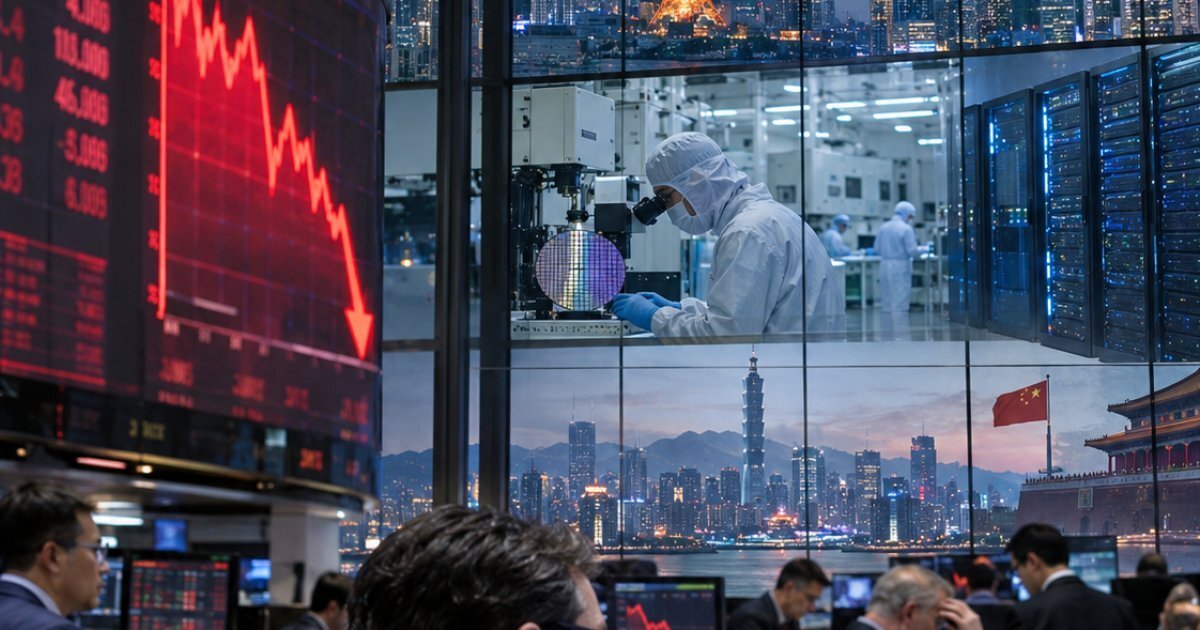
Markets entered a global AI stock sell-off after the 2026 US midterm elections, sending major technology and semiconductor markets sharply lower in the United States, Japan, South Korea and Taiwan. The declines reflected investor concerns that Democrats’ gains could lead to stricter AI regulation, delays to data-center construction and greater scrutiny of the huge capital spending plans supporting the industry.
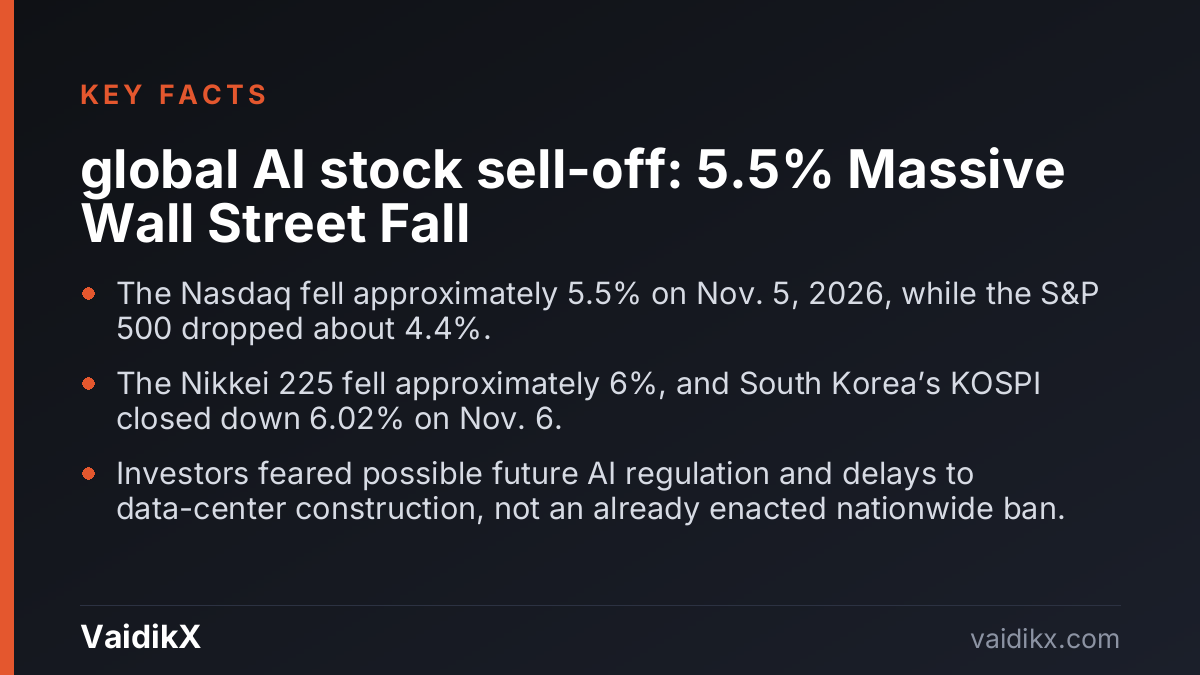
One report put the S&P 500’s drop at about 4.4% on Nov. 5, 2026, as the global AI stock sell-off hit US markets.
The global AI stock sell-off reached beyond Wall Street, with Asian markets also falling after the US midterm elections. CNN reported on the wider market rout, which it described as global stocks reeling over AI fears. The global AI stock sell-off has made investors more cautious about AI valuations across the region.
Key Takeaways
- Investors feared possible future AI regulation and delays to data-center construction, not an already enacted nationwide ban.
- The S&P 500 fell about 4.4% on Nov. 5, 2026, in one report on the global AI stock sell-off.
The election result did not create a confirmed nationwide ban on new data centers, and no such policy was reported in the supplied coverage. Instead, the market reacted to the possibility of future restrictions at a time when investors were already questioning whether AI infrastructure spending, company valuations and expected returns had moved too far ahead of one another.
Why the global AI stock sell-off spread after the US midterm election
The Nasdaq market decline showed how heavily the selling was concentrated in growth and technology shares. Companies connected to AI computing, chips and data-center equipment had benefited from strong expectations around future demand, leaving them particularly exposed when investors began reassessing the cost and political risks of that expansion.
Democrats made sweeping gains in the midterm elections. The election outcome raised concerns among investors that a changed balance of power in Washington could increase pressure for AI oversight, including possible limits or delays affecting new data-center projects.
These were market concerns about potential future policy, not evidence that Congress had already stopped data-center construction. The uncertainty mattered because the AI boom depends on large investments in servers, advanced processors, electricity and facilities. If those projects face longer approval timelines or tighter rules, investors may question the speed at which expected revenue can arrive.
The other concern was financial. Major technology companies are committing enormous sums to AI infrastructure, while investors are still waiting to see whether the resulting products and services will generate returns quickly enough. A company can report strong demand for computing capacity while its spending remains high for years; that gap between investment and payback has become central to the market debate.
As the election added a new source of uncertainty, investors reduced exposure to highly valued technology and semiconductor stocks. That global AI stock sell-off therefore reflected several pressures at once: political risk, expensive infrastructure plans, elevated valuations and doubts about the timing of future returns.
Asian markets followed Wall Street lower
The regional impact was especially severe because Japan, South Korea and Taiwan are closely tied to the global technology supply chain. Semiconductor manufacturers, memory-chip producers, chip-testing companies and equipment suppliers all face investor pressure when expectations for AI hardware demand or data-center expansion weaken. Taiwan semiconductor stocks were therefore among the areas exposed to the shift in expectations.
The supplied reporting identifies heavy selling in NVIDIA, AMD, Micron, Samsung Electronics, SK Hynix, TSMC, SoftBank Group, Advantest and Tokyo Electron. It does not provide a complete set of exact price changes for each company. [EDITOR NEEDED: Add a verified table of each named company’s closing price change, clearly labeled by trading date and distinguishing closing losses from intraday or weekly moves.]
Newsletter
Get the VaidikX AI Brief
The week's biggest AI, Big Tech and startup news, explained in 5 minutes. Free, every week.
What the sell-off means for US readers
For US investors and businesses, the immediate significance is that a domestic political development quickly changed the risk assessment for a global industry. AI companies may be headquartered in the United States, but their hardware supply chains and investor bases extend across Asia. A shift in expectations for US policy can therefore affect chipmakers, equipment companies and technology-focused funds far beyond Wall Street.
The connection is also practical. Data centers require advanced processors, memory, semiconductor manufacturing capacity and specialized production equipment. If investors expect fewer facilities to be approved, or believe companies will slow construction to control spending, the concern can move through the entire chain rather than remain limited to software companies.
For readers following the US midterm election stock market reaction, the key distinction is between political possibility and enacted policy. Democrats’ election gains changed expectations about regulation, but the supplied sources do not report a nationwide restriction that had already taken effect. The market response was based on uncertainty combined with existing worries about AI investment.
This global AI stock sell-off leaves several questions unresolved. Investors will be watching whether US lawmakers pursue AI rules that affect data centers, whether companies maintain their planned infrastructure spending and whether corporate earnings begin to justify the scale of those investments.
China and Hong Kong did not move in lockstep
Across the region, the global AI stock sell-off was not uniform. Mainland Chinese and Hong Kong markets did not mirror every move in Japan, South Korea and Taiwan. The CSI 300 and Hang Seng followed different patterns from the other major Asian benchmarks, showing that the decline was not identical across every market.
The supplied material does not provide the exact CSI 300 and Hang Seng percentage changes needed for a precise comparison. [EDITOR NEEDED: Insert the verified closing changes for the CSI 300 and Hang Seng, including the trading date and a brief explanation of how each differed from the Nikkei 225, KOSPI and Taiex.]
That difference matters because national market indexes have different sector mixes and respond to different domestic economic and policy factors. A worldwide repricing of AI exposure can be powerful without producing identical results in every exchange.
What investors will be watching next
Investors will also be assessing whether this global AI stock sell-off was a temporary reduction in risk or a broader reassessment of AI valuations. The available reporting does not establish that an AI bubble has definitively burst, nor does it show that a global technology downturn must continue. It does show how quickly concerns about regulation and capital spending can amplify existing doubts and move through interconnected markets.
The election’s market effect was therefore less about a confirmed policy change than about revised expectations. US political developments altered how investors viewed the cost, timing and potential payoff of AI infrastructure, and that repricing reached companies and markets tied to the technology economy worldwide.
For further election context, see VaidikX’s report on the 2026 US midterm election results. The market story remains open: regulation, data-center investment and corporate earnings will determine whether this episode fades or becomes a longer reassessment of AI’s financial promise.
Get the VaidikX AI Brief, free
More from VaidikX
 Business & StartupsMicrosoft $25 billion bond sale comes as it offers buyouts to about 60,000 eligible employees
 Business & StartupsWonderful Raises $550M at $5B Valuation to Build an Enterprise AI Operating System
 Business & StartupsMicrosoft voluntary exit offer opens to about 60,000 employees in four countries