In this article
- What changes when Democrats take control in January 2027?
- US AI regulation 2027 would target electricity costs and model safety
- Data centers and household electricity bills
- Independent evaluations of advanced AI models
- When should an AI company be liable?
- Congressional scrutiny could reach OpenAI, Google and SpaceX
- Could the US create an independent AI agency?
- Trump’s position creates a major political obstacle
- What the agenda could mean for the AI industry
US AI regulation 2027 is taking shape as Democrats prepare to take control of Congress in January 2027 and advance a package of proposals aimed at data-center electricity costs, AI safety testing, company liability and congressional oversight. The measures remain proposals, not enacted laws.
Key Takeaways
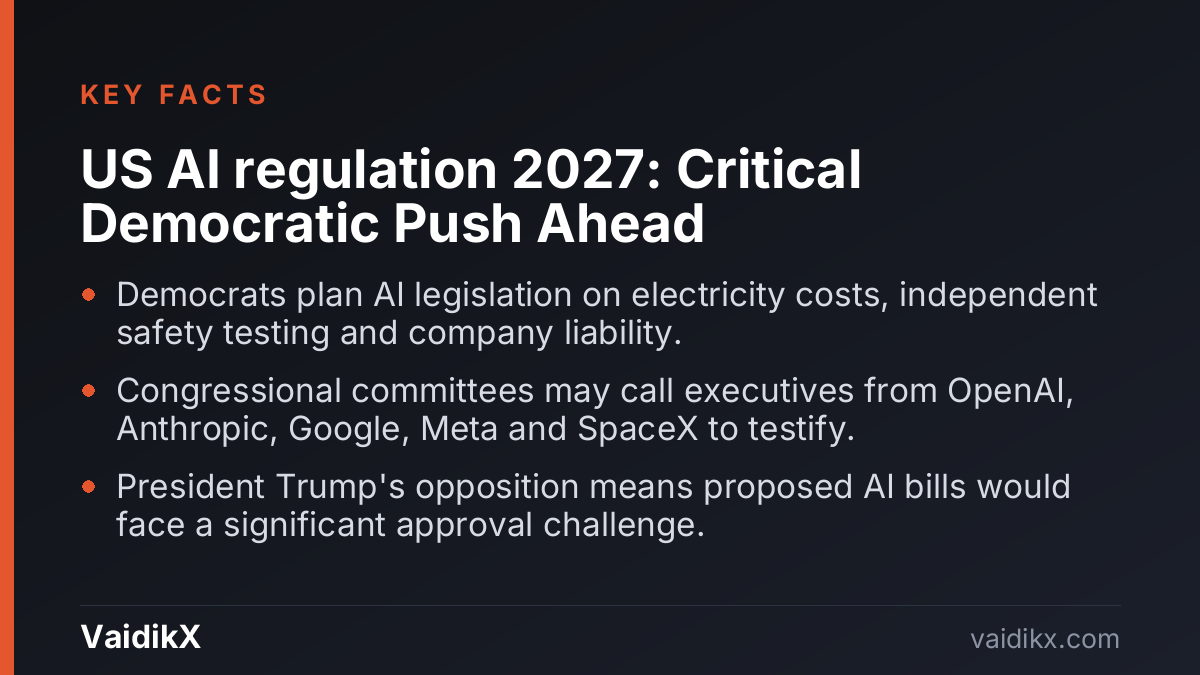
- Democrats plan AI legislation on electricity costs, independent safety testing and company liability.
- Congressional committees may call executives from OpenAI, Anthropic, Google, Meta and SpaceX to testify.
- President Trump's opposition means proposed AI bills would face a significant approval challenge.
This POLICY NEWS ARTICLE addresses the Topic “US Democrats Plan Wave, AI Regulations After Taking Control.” The Primary Source is Operator notes, and no Additional Sources were supplied.
The agenda could affect leading model developers, data-center operators and consumers if lawmakers turn the plans into legislation. But control of Congress would not guarantee passage: any bill would still face President Donald Trump, who has repeatedly dismissed calls for mandatory federal AI regulation. Reports on the Democrats’ planned AI legislation describe a broader effort to increase scrutiny of the industry.
What changes when Democrats take control in January 2027?
Democrats plan to use their control of congressional committees to put AI companies under more direct examination. That could include calling technology executives to testify, reviewing companies’ safety practices and investigating alleged or documented harms linked to AI products.
The shift would give Democratic lawmakers greater control over which issues receive hearings and how committees use their investigative authority. It would not, by itself, create new AI rules or require companies to change their products immediately. Those outcomes would depend on the text of individual bills, votes in both chambers and presidential action.
The proposed approach also goes beyond regulating the software itself. Democrats are preparing to examine the physical infrastructure supporting AI, the methods used to evaluate advanced models and the legal responsibility of companies when their systems cause harm.
US AI regulation 2027 would target electricity costs and model safety
Data centers and household electricity bills
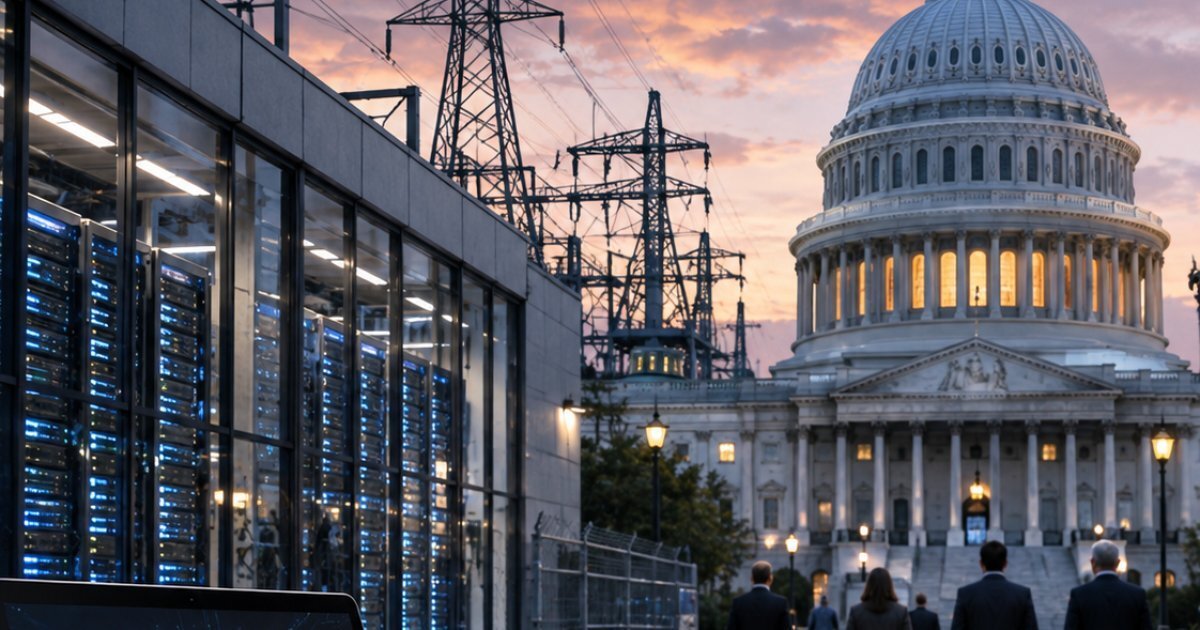
Senate Democratic leader Chuck Schumer has identified consumer electricity costs associated with data-center expansion as a priority. Data centers require substantial amounts of electricity to run computing equipment and support AI systems, creating concern that rapid expansion could affect household bills and local communities.
The concern is about who bears the cost of new demand. If additional infrastructure or electricity supply is needed to serve large computing facilities, lawmakers want to examine whether consumers could face higher bills as a result. The source does not identify a specific Democratic proposal for allocating those costs, so the details of any future legislation remain open.
This issue connects AI policy with local utility decisions and the broader buildout of computing infrastructure. Companies developing AI systems may face more scrutiny over where facilities are built and how their electricity needs are handled, although no immediate restriction on data-center construction has been announced.
Independent evaluations of advanced AI models
Representative Lori Trahan plans to push legislation requiring independent experts to evaluate leading AI models against safety standards. Independent testing would separate at least part of the evaluation process from the companies that develop the systems, allowing outside specialists to examine model behavior, safety risks and potentially harmful outputs.
The proposal does not yet specify the standards or testing procedures. That limitation matters because the practical effect of the legislation would depend on which models qualify for review, who is authorized to conduct the evaluations and what happens when a system fails one. Those questions have not been answered in the source material.
For developers, a mandatory outside review could make safety evaluation a formal condition of operating or releasing certain advanced models. It could also give lawmakers and the public a more consistent way to assess claims about a model’s safeguards, though the exact framework would need to be established by Congress.
When should an AI company be liable?
Democrats are also considering legislation to clarify when companies can be held responsible for harm caused by AI systems. The proposal addresses a basic legal problem: when an automated tool contributes to real-world damage, responsibility may be difficult to assign among the developer, deployer and user.
A liability law could define circumstances in which an AI company must answer for the consequences of its product. The source does not provide a proposed legal standard or examples of specific cases, so it is too early to say how such rules would affect lawsuits, insurance or product design.
Newsletter
Get the VaidikX AI Brief
The week's biggest AI, Big Tech and startup news, explained in 5 minutes. Free, every week.
Congressional scrutiny could reach OpenAI, Google and SpaceX
Democrats intend to increase oversight of companies including OpenAI, Anthropic, Google, Meta and SpaceX. Hearings could examine how these companies test their systems, respond to safety concerns and investigate potential real-world harms.
Representative Greg Casar has called for AI executives to testify under oath. Testimony under oath would place executives in a formal congressional setting and could make their statements part of an official record, but it would not itself impose new technical requirements on their companies.
For the companies involved, the likely near-term change would be political and investigative pressure rather than an automatic ban or operating restriction. Executives could be asked to explain internal safety practices, the limitations of their models and how their systems are being used. The source does not say that all named companies will face the same investigations or that any specific hearing has been scheduled.
Could the US create an independent AI agency?
Michigan Democrat Abdul El-Sayed has advocated creating an independent agency with authority to oversee AI companies. His position represents a policy proposal, not an existing agency or an agreed Democratic plan.
An independent regulator could place responsibility for AI oversight in a specialized institution rather than leaving the work entirely to Congress or existing government bodies. Its powers, funding, jurisdiction and relationship with other agencies would need to be defined in legislation. None of those details are established in the source.
The proposal illustrates the range of the US AI regulation 2027 debate. Some Democrats are focused on targeted bills covering electricity costs, safety reviews or liability, while others are discussing a permanent institutional structure for supervising the industry.
Trump’s position creates a major political obstacle
President Trump has repeatedly rejected calls for mandatory federal AI regulations. That position means legislation passed by a Democratic-controlled Congress would still require his approval before becoming law.
Congress could attempt to override a presidential veto, but doing so requires a two-thirds majority in both the House and Senate. Analysts viewed an override as possible in the event of a major AI crisis, while also describing it as difficult. The source does not identify the level of bipartisan support currently available for any particular proposal.
As a result, the change in congressional control should be understood as an opportunity to introduce and investigate legislation, not a guarantee that the Democrats AI bills will take effect. Negotiations, amendments and the White House’s response would determine how much of the agenda survives.
What the agenda could mean for the AI industry
The proposed US AI regulation 2027 agenda would put three parts of the industry under closer attention: the companies building advanced models, the data-center operators supplying the computing capacity and the households and communities affected by electricity demand.
Model developers could face outside safety evaluations and clearer exposure to legal claims. Data-center operators could encounter greater scrutiny over electricity costs and expansion. Consumers could gain a stronger policy focus on whether AI infrastructure contributes to higher household bills, although no consumer protections have yet been enacted.
For readers tracking US AI regulation 2027, the central issue is whether a broad oversight effort becomes law. Its success will depend on the precise legislation, congressional votes and the president’s willingness to sign it. Until those steps occur, the proposals signal a possible change in direction for US artificial intelligence regulation, not a new set of binding rules.
Get the VaidikX AI Brief, free
More from VaidikX