In this article
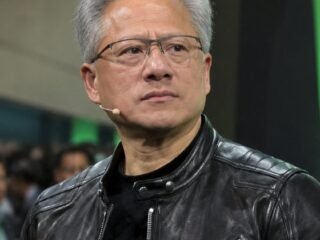
Jensen Huang steps down as Nvidia CEO on Nov. 12, 2026, ending more than three decades at the company he co-founded. As Jensen Huang steps down, he is also leaving Nvidia’s board, while Chief Financial Officer Colette Kress becomes interim CEO as the company searches for a permanent successor.
Key Takeaways
- Jensen Huang left Nvidia’s CEO role and board on Nov. 12, 2026, after more than three decades.
- CFO Colette Kress became interim CEO while Nvidia searches for a permanent successor.
- Nvidia shares fell more than 10% in premarket trading after the leadership announcement.

The change reaches beyond Nvidia’s corporate structure. Jensen Huang steps down after helping turn the company from a graphics-chip maker into the leading supplier of computing hardware used for artificial intelligence. Nvidia’s chips and systems now sit at the center of data-center expansion and AI model development, making the transition a test of the company’s strategy, investments and relationships across the AI infrastructure market.
Who leads Nvidia after Jensen Huang steps down?
Kress will run Nvidia on an interim basis. As the company’s finance chief, she is familiar with its operations, but Nvidia has not named her as the permanent CEO. The board will conduct a search for a long-term replacement.
Harvey Jones will become Nvidia’s first board chairman. The chairman leads the board and its corporate-governance work, while the CEO is responsible for executive management and business operations. Jones’s appointment gives Nvidia a new leader at the board level as Kress assumes temporary responsibility for running the company.
That makes succession planning an immediate business issue. Nvidia is closely associated with its founder, so investors and customers will be watching whether the company can preserve its direction as Jensen Huang steps down from leading its public strategy and relationships across the technology industry.
Why Jensen Huang steps down
The circumstances surrounding the departure involve a series of reports and an independent board review. Reports described an extramarital relationship involving Alice Huang, a former Megaspeed executive. Huang publicly admitted infidelity and apologized to his family and employees.
Separate reporting raised US intelligence concerns involving Alice Huang and alleged links to China. Those allegations remain distinct from Huang’s admitted personal conduct. The available account does not establish that Huang committed espionage, knowingly assisted a foreign intelligence operation or that the intelligence-related claims were proven.
Nvidia’s board opened an independent investigation after the reports emerged. Subsequent reporting described another alleged relationship involving a company executive who reportedly worked under Huang. The board was reported to have considered Huang’s future before he ultimately departed.
VAIDIKX previously reported on the Nvidia controversy and continuing board investigation. A separate report covered the independent review of foreign intelligence concerns. Neither the existence of an investigation nor the reported allegations, by itself, proves wrongdoing beyond the conduct Huang acknowledged.
Newsletter
Get the VaidikX AI Brief
The week's biggest AI, Big Tech and startup news, explained in 5 minutes. Free, every week.
Nvidia stock reaction separates market fear from business facts
Nvidia shares fell more than 10% in premarket trading after the leadership news, according to Reuters. That was a premarket move, not a regular-session closing price, and the supplied reporting does not provide a verified closing price or updated market capitalization. Those figures should be confirmed separately before publication.
The reaction reflected concern about continuity and investor confidence. Markets had treated Huang as central to Nvidia’s long-term direction, so as Jensen Huang steps down, his exit creates uncertainty over decisions that extend beyond quarterly financial results. The company’s size and importance to the AI hardware market make a sharp share-price move relevant to other businesses tied to data centers and AI infrastructure.
The stock reaction does not show that Nvidia’s hardware demand has collapsed. It shows that investors are reassessing leadership risk and the possibility that the company’s strategy could change under a new executive team.
Why Huang mattered to the AI hardware ecosystem
Huang’s importance came from the combination of product strategy, software and industry relationships. Nvidia’s graphics processing units, or GPUs, became central to AI computing, while its CUDA software ecosystem helped developers use those processors for workloads beyond graphics. That combination supported Nvidia’s position as AI development expanded.
Huang also shaped Nvidia’s long-term AI strategy and maintained relationships with major cloud providers, AI laboratories and other technology companies. The company has made investments and arranged financing that support parts of the wider AI infrastructure ecosystem. Analysts cited in the reporting have questioned whether another leader can replace Huang’s strategic vision and industry influence if Jensen Huang steps down without changing that approach.
For customers, this matters because Nvidia is not simply selling an isolated chip. Its hardware, software and business relationships form part of the computing infrastructure used to train and operate AI systems. A change in leadership could affect how Nvidia prioritizes customers, investments and financing, even if its existing products remain in demand.
Could Nvidia’s leadership change affect the AI industry?
US cloud companies, AI laboratories, data-center operators and businesses building AI products are among the organizations affected by Nvidia’s decisions. If the company’s investment or customer-financing strategy changes, those businesses could face a different relationship with one of the most important suppliers in the AI semiconductor market.
Consider a data-center company planning capacity around Nvidia systems. The immediate need for those systems may remain strong, but the customer would still care about supply commitments, financing arrangements and the company’s willingness to support long-term infrastructure projects. The source does not establish that any of those arrangements have changed; it identifies them as issues investors are watching after Jensen Huang steps down.
The broader AI boom also does not end because Nvidia has a new interim leader. Nvidia supplies chips and computing systems used by major AI companies, and demand for that hardware may continue during the leadership transition. The open question is whether the company’s strategy and influence will remain stable while it searches for a permanent CEO.
What happens next at Nvidia
Kress will lead during the interim period, while Jones oversees the board as chairman and directors search for a permanent CEO. Nvidia has not announced who will receive that job, and speculation about possible successors should not be treated as a confirmed succession plan.
The company’s next quarterly financial results are scheduled for Nov. 17, 2026. That update will give investors a formal opportunity to assess Nvidia’s business performance, but it may not immediately answer the larger questions about leadership, customer financing or the company’s investment strategy.
The most consequential part of Jensen Huang steps down is the separation of Nvidia’s future from its founder’s direct leadership. Kress provides interim continuity, but the permanent successor will have to demonstrate that Nvidia can maintain its AI position while managing the expectations of customers, investors and the companies building the next generation of computing infrastructure.
Get the VaidikX AI Brief, free
More from VaidikX