In this article
A nationwide FAA ground stop ended after roughly five hours on Friday, Nov. 13, 2026. Departures resumed after the FAA ground stop and the Federal Aviation Administration tested its systems and found them stable, but airlines still had to reposition aircraft and crews.
Key Takeaways
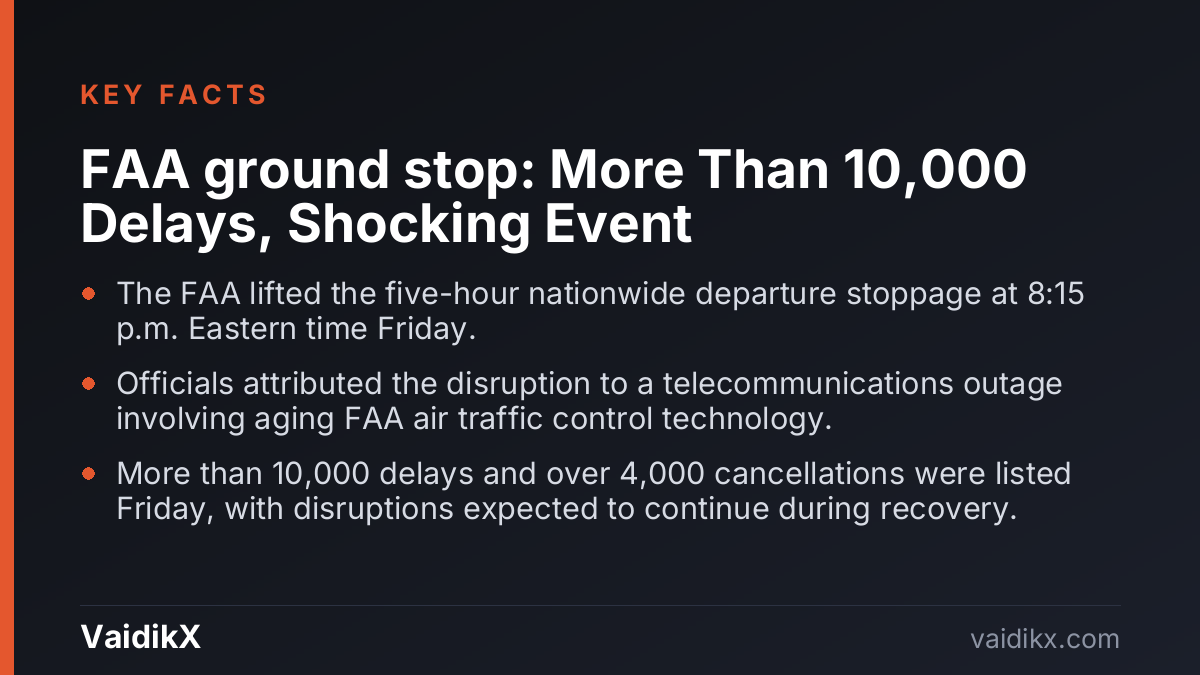
- The FAA lifted the five-hour nationwide departure stoppage at 8:15 p.m. Eastern time Friday.
- Officials attributed the disruption to a telecommunications outage involving aging FAA air traffic control technology.
- More than 10,000 delays and over 4,000 cancellations were listed Friday, with disruptions expected to continue during recovery.
FlightAware listed more than 10,000 delays and over 4,000 cancellations that day. Transportation officials attributed the disruption to a telecommunications failure affecting air traffic control, not to a confirmed security event. Because these figures and explanations came from Friday night reports, individual flight statuses and the wider recovery may have changed.
What triggered the FAA ground stop
Officials said an FAA ground stop paused departures after radar and communications equipment became unreliable at FAA facilities across the country. The FAA cited “extraordinary circumstances and for reasons of safety” when it ordered the stoppage.
Transportation Secretary Sean Duffy said the trouble began at 3:36 p.m. Eastern time. In his account, outdated air traffic control equipment and routers overloaded by data produced inconsistent information. Shutting down the affected system was safer than continuing to operate with unreliable data.
CBS News reported on the nationwide FAA disruption that an update to the private network linking the FAA’s air traffic control system caused a reboot, followed by a crash and communications outage, according to sources familiar with the matter. L3Harris operates that network and had not immediately answered CBS News’ request for comment.
Homeland Security Secretary Markwayne Mullin offered a similar explanation, saying security patches added to the older system appeared to overload its routers. That remains an official account, not a completed technical investigation.
How the FAA ground stop was lifted
The FAA ground stop applied to departing flights. Planes already airborne continued toward landing under existing procedures. Duffy said more than 3,500 aircraft were in the sky when the pause began, with fewer than 400 still airborne by 8 p.m. Eastern time. A separate estimate cited by CBS News counted about 3,100 aircraft bound for US airports at the start.
Medical evacuation flights, lifesaving cargo missions and law enforcement operations were permitted to continue, Duffy said. Mullin said officials had assurance that aircraft already in flight could land safely.
Duffy announced at 8:15 p.m. Eastern time that the airspace had reopened. Before doing so, the FAA tested its systems and confirmed that operations were stable and reliable.
Reopening the airspace restarted departures but did not immediately restore the schedule. Duffy said officials would move as many flights as possible Friday night, subject to available crews, while airline partners could handle some aircraft on Saturday. Major airports began restoring service in limited stages.
Newsletter
Get the VaidikX AI Brief
The week's biggest AI, Big Tech and startup news, explained in 5 minutes. Free, every week.
Why the disruption reached travelers nationwide
The effects of the FAA ground stop lasted longer than the departure ban itself. Aircraft and flight crews ended up away from their planned locations, connections were missed, and airline schedules filled with delays and cancellations.
American Airlines said it would prioritize non-hub and international flights while rebuilding its schedule. Southwest planned a limited Friday evening restart and said it would match flights to available aircraft and crews. United and Delta also resumed parts of their operations; Delta cautioned that returning people and planes to the right places would take time.
Air Canada canceled US flights for the rest of Friday evening. It also warned that some Canada-Caribbean and Canada-South America services using US airspace might be affected. Mexico’s Federal Civil Aviation Agency said flights from Mexico to the United States would resume gradually after receiving word that US operations had restarted.
Residual delays affected other federal work as well. The National Transportation Safety Board said it would send investigators by road to examine a vessel collision in New Orleans instead of flying a board member to the scene.
What officials said about cybersecurity
Mullin said briefings had produced no sign of a “nefarious act” or a threat to the country. He also said the failure was unrelated to the large worldwide Microsoft outage and that officials had found no cyberattack.
Those comments reflected the information available during the briefings. The reports did not include a final technical finding beyond the telecommunications failure, the reboot and the reported router problems.
What affected passengers should do
Passengers should check their airline’s latest notice before leaving for the airport. Duffy said reopening the airspace did not mean every flight would depart at once and warned that the return to normal would be gradual.
Each carrier set its own remedy. American said affected travelers could seek refunds. Southwest allowed customers to cancel or rebook without fees, while United offered rebooking without change charges or fare differences. Delta said it would rebook travelers whose flights were canceled and permit flexible changes without an added cost.
A listed departure after the FAA ground stop may not follow its original timetable. Travelers should rely on the airline’s current status because carriers said aircraft and crews might take until Saturday to reach the places where they were needed.
The failure also brought renewed attention to the US air traffic control network. The FAA Telecommunications Infrastructure, known as FTI, moves operational data and voice traffic between control centers and other FAA facilities. A November 2023 review commissioned by the FAA called the network obsolete and warned that an unexpected failure could cut off one facility or an entire regional control center.
Duffy requested emergency money to modernize the system. Mullin said replacing the network would be preferable to continuing with small repairs and estimated a full replacement at $50 billion. Those figures are administration proposals and estimates, not an approved modernization program.
Another nationwide FAA failure occurred in January 2023, when a flight personnel alert system outage delayed domestic service. Friday’s event affected departures across the country and involved communications equipment that officials said had to be taken offline until testing was complete. For travelers, the practical result was that lifting the FAA ground stop marked the beginning of the recovery, not an immediate return to normal schedules.
Get the VaidikX AI Brief, free
More from VaidikX