In this article
Blinken India right to defend itself was the central message former US Secretary of State Antony Blinken delivered on Nov. 14, when he said the United States must respect India’s right to respond to attacks and maintain a zero-tolerance policy toward terrorism. He made the remarks at the Hindustan Times Leadership Summit 2026 in New Delhi during a conversation with Jawed Ashraf, chairman of the India Trade Promotion Organisation.
Key Takeaways
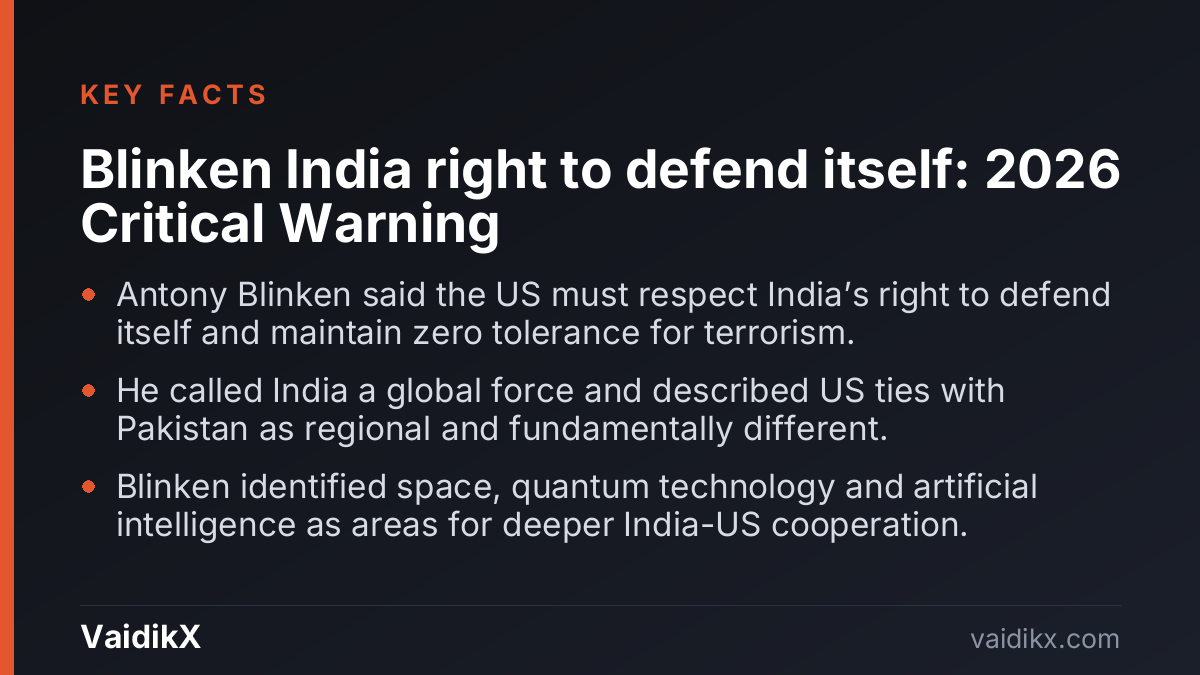
- Antony Blinken said the US must respect India’s right to defend itself and maintain zero tolerance for terrorism.
- He called India a global force and described US ties with Pakistan as regional and fundamentally different.
- Blinken identified space, quantum technology and artificial intelligence as areas for deeper India-US cooperation.
Blinken was speaking as a former US official, not announcing a change in current US government policy. His comments addressed how Washington should support India while trying to prevent a dangerous escalation between India and Pakistan, which are both nuclear-armed countries. The phrase Blinken India right to defend itself captures the security principle he was discussing. The report by DT Next attributed the remarks to Blinken’s discussion at the summit.
Blinken India right to defend itself: What he said
Blinken said the United States should pursue two goals at once: support India’s efforts to respond to attacks and use diplomacy to reduce the risk of a broader confrontation with Islamabad. The Blinken India right to defend itself argument therefore included both security support and diplomatic restraint. He described that balance as necessary because military escalation between India and Pakistan could have severe consequences given their nuclear capabilities.
“We have to have a zero-tolerance policy for terrorism,” Blinken said. He added that this principle required the United States to respect India’s right to defend itself. The Blinken India right to defend itself position reflects his view of how Washington should approach terrorism and South Asian security; it was not a formal announcement from the current US administration.
That argument formed part of a wider comparison between India and Pakistan’s roles in US foreign policy. Blinken called India a global force and said its shared interests with the United States extend across the world. He described the US relationship with Pakistan as regional, while acknowledging that Washington still has important reasons to work with Islamabad, including counter-terrorism.
Why Blinken sees India and Pakistan differently
Blinken said successive US administrations may have been less critical of Pakistan’s civil-military establishment because of American strategic interests during the Cold War and the war in Afghanistan. He said there was an opportunity for the United States to do more, although he did not outline specific policy or actions.
This history helps explain why he paired support for India’s security concerns with diplomacy. His remarks did not describe support for an unrestricted military response. Instead, he argued that Washington should recognize India’s right to respond to attacks while working to prevent tensions from becoming a larger conflict.
For India, the distinction matters. Blinken India right to defend itself is a position that supports the principle that counter-terrorism policy should not automatically prevent India from responding to attacks. At the same time, his emphasis on de-escalation indicates that, in his view, support for India must exist alongside diplomatic engagement aimed at limiting the danger of conflict.
Newsletter
Get the VaidikX AI Brief
The week's biggest AI, Big Tech and startup news, explained in 5 minutes. Free, every week.
What it means for India-US ties
Blinken described the relationship between Washington and New Delhi as having moved from estrangement to a strategic partnership. He linked that change to shared strategic interests and people-to-people connections between the two societies.
He identified cooperation in emerging technologies as an important next stage, naming space, quantum technology and artificial intelligence. The source provides no details of new agreements, funding, programs or timelines in those fields, so his remarks identify priorities rather than announce a specific technology initiative.
His comments on India’s right to defend itself fit within that broader description of India as a long-term strategic partner. The Blinken India right to defend itself message suggests that, in his assessment, the relationship extends beyond a single security issue to technology, diplomacy and connections between citizens. They do not mean the United States and India will agree on every international question.
India’s Russia ties remain an area of difference
Blinken acknowledged that India’s relationship with Russia has deep historical roots. He said Washington did not expect New Delhi to end those ties, while recognizing that the two countries would sometimes hold different perspectives.
That comment places his Blinken India right to defend itself argument within a more flexible view of the partnership. Blinken presented cooperation with India as compatible with disagreement on selected issues, rather than requiring New Delhi to align completely with Washington.
The same discussion covered the effect of domestic political developments and midterm elections on US international engagement. The US midterm election results are part of that wider political context, although the source does not connect a specific election result to a new India policy.
Wider regional risks discussed by Blinken
The summit conversation also covered conflicts in West Asia, including the continuing confrontation involving the United States, Israel and Iran. Blinken stressed the need to prevent a wider regional war and discussed the risks such conflicts pose to regional stability and international security.
He discussed the strategic importance of the Strait of Hormuz, which the source describes as critical for global energy supplies. Disruption to shipping through the strait could have international implications, but the source provides no forecast, disruption estimate or specific response plan.
These remarks show why his comments on India should not be read as a stand-alone policy announcement. Blinken was discussing several connected security challenges, including terrorism, India-Pakistan tensions, West Asian conflicts and the effects of political change in the United States.
What remains open after the remarks
Blinken did not specify what forms of support the United States should provide if India responds to an attack. He also did not set out a new mechanism for diplomacy between New Delhi and Islamabad, identify conditions for US involvement or explain how Washington should respond to particular future events.
The practical takeaway is therefore narrower than a formal policy shift. The Blinken India right to defend itself argument was that the United States should recognize India’s right to protect itself, reject terrorism without qualification and use diplomacy to prevent a nuclear-armed crisis from becoming wider. The current US government’s position and any future actions were not established by these remarks.
Source: DT Next
Get the VaidikX AI Brief, free
More from VaidikX