In this article
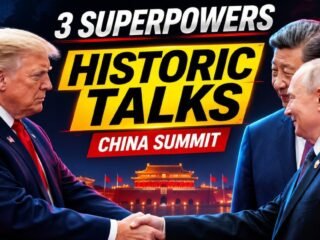
The Trump Putin Xi talks ended Thursday with a brief statement on cooperation, not a settlement for the wars in Ukraine or Iran. The United States, Russia and China also made no deal on reducing nuclear arsenals or allowing inspections. Their first three-way summit instead focused on United Nations reform, refined petroleum supplies, protections for state officials and dialogue about nuclear risks.
Key Takeaways
- The four-point declaration covers UN reform, refined petroleum supplies, official immunity and nuclear-risk dialogue.
- The document does not mention Ukraine, Iran, nuclear-arms reductions or inspections.
- No date was announced for the promised dialogue on reducing nuclear risks.
The meeting in the Trump Putin Xi talks brought Donald Trump, Vladimir Putin and Xi Jinping together while their governments remain divided over Ukraine, Iran, trade, nuclear weapons and the wider security system. The four-point text creates subjects for future contact but leaves the hardest disputes open. Reuters’ report on the meeting said Trump left for the United States after the document appeared; the leaders did not deliver a joint statement in person.
What came from the Trump Putin Xi talks in Shenzhen
The Trump Putin Xi talks took place at Kylin Villa in Shenzhen during the 33rd Asia-Pacific Economic Cooperation leaders’ meeting. The Nation put the session at about one hour and 20 minutes, while The Sunday Guardian described it as lasting more than an hour.
Xinhua and the Kremlin published a text called the “Statement by the Heads of State of China, Russia, and the United States on Peace.” The Sunday Guardian described the document as roughly 250 words, covering four subjects:
- Reforming the United Nations so it can respond more effectively to global challenges.
- Expanding the production and supply of refined petroleum products while supporting stable energy flows.
- Respect for state consent and official immunity, alongside a warning that the International Criminal Court and comparable bodies should not abuse their jurisdiction.
- Recognition that a nuclear war cannot be won and must never be fought, alongside dialogue to reduce nuclear risks and prevent proliferation.
None of these points includes a delivery target, an energy project, a negotiating schedule or an enforcement mechanism. The Trump Putin Xi talks therefore produced a statement of shared positions rather than an operating plan. No date was set for the proposed nuclear-risk dialogue.
Ukraine and Iran stayed outside the published text
Within the Trump Putin Xi talks, Ukraine featured in Trump’s separate conversation with Putin before the three-country session. The Kremlin said that exchange lasted between 35 and 40 minutes and was preparatory. Trump later told Xi that Washington and Beijing could assist efforts to end the Russia-Ukraine war.
Putin said the three governments had common interests in resolving regional conflicts, including Ukraine. Xi’s opening remarks did not name Ukraine; he spoke instead about harmony among major powers as a condition for peace. Kremlin spokesman Dmitry Peskov later said Ukraine was not the summit’s main subject.
Iran, North Korea and weapons reductions are also absent from the published statement. The Sunday Guardian said the Trump Putin Xi talks produced no public pledge from Xi and Putin to help end the Iran war, although Trump said all three leaders agreed that Iran should not acquire a nuclear weapon. The report added that neither Xi nor Putin publicly referred to Iran during the APEC meetings.
The omission defines the limits of the Trump Putin Xi talks. The leaders endorsed negotiation in general terms and discussed reliable energy supplies, but they did not address the conflicts that placed the most pressure on the meeting.
Newsletter
Get the VaidikX AI Brief
The week's biggest AI, Big Tech and startup news, explained in 5 minutes. Free, every week.
Nuclear discussion did not become arms control
Trump had wanted China involved in arms-control discussions with Washington and Moscow. A Sunday Guardian report said bringing Beijing into the process was a major reason Trump pursued the Trump Putin Xi talks, since the United States and Russia possess much larger nuclear arsenals than China.
The nuclear section of the Trump Putin Xi talks establishes no ceiling for warheads, inspection system, verification process or reduction timetable. The same publication said Xi had used the wording about an unwinnable nuclear war for years, making it a restatement of an existing position rather than a new bargain.
Separately, Xi supported a comprehensive ban and destruction of nuclear weapons, calling them a “sword of Damocles hanging over humanity.” The signed text goes no further than dialogue on nuclear risks and proliferation. Our earlier report on Xi’s nuclear-weapons proposal explains the difference between a call to abolish these weapons and the narrower promise made by the three governments.
Trump said, “Once you have the nuclear weapons, it’s very hard to not have them.” The governments announced no follow-up session.
What the outcome means for US policy
The energy language from the Trump Putin Xi talks could support limited coordination, but it does not immediately change American fuel supplies. Trump said he and Xi wanted oil to keep moving through the Strait of Hormuz, where shipping has been disrupted by the Iran war. The text does not name the strait or set out a joint action.
Its section on international courts carries a separate political message. The text supports immunity for state officials and objects to what it describes as improper use of jurisdiction by the ICC and similar institutions. Reporting by The Sunday Guardian said Putin faces an ICC arrest warrant connected to the Ukraine war. Trump has called the court a “rogue globalist organisation,” and his administration has sanctioned ICC members.
For Washington, leaving Ukraine out also raises the question of who would shape any future settlement. Ukrainian President Volodymyr Zelensky called Trump’s private meeting with Putin a mistake and said Ukraine must participate in decisions about its own future. Ukrainian officials asked Washington and Beijing to push Putin to end the war and cautioned against restoring spheres of influence.
No settlement was published, Ukraine did not sign the statement and no wider peace timetable was confirmed. Putin said Washington was asking Russia to accept European involvement in later negotiations. The Kremlin did not verify a subsequent report that he had accepted that condition.
Contact increased, but the disputes remain
All three governments described the encounter in favorable terms. Xi called it positive, constructive and fruitful. Putin said the exchange was open and candid and helped the leaders understand each other. Trump said the countries were making history and called the visit highly consequential.
The setting also gave Putin a visible meeting with the leaders of the United States and China after Russia had faced broad diplomatic isolation since its full-scale invasion of Ukraine. The Sunday Guardian portrayed the appearance as giving Moscow some diplomatic legitimacy and allowing Xi to present China as an influential diplomatic actor.
That symbolism did not resolve the substantive disputes. The Trump Putin Xi talks identified four possible areas of cooperation but avoided the issues most likely to prevent agreement. The statement keeps communication possible, yet its missing deadlines, enforcement rules and conflict-specific commitments leave the practical result narrow.
Source: The Moscow Times, The Sunday Guardian, The Nation
Get the VaidikX AI Brief, free
More from VaidikX