
In this article
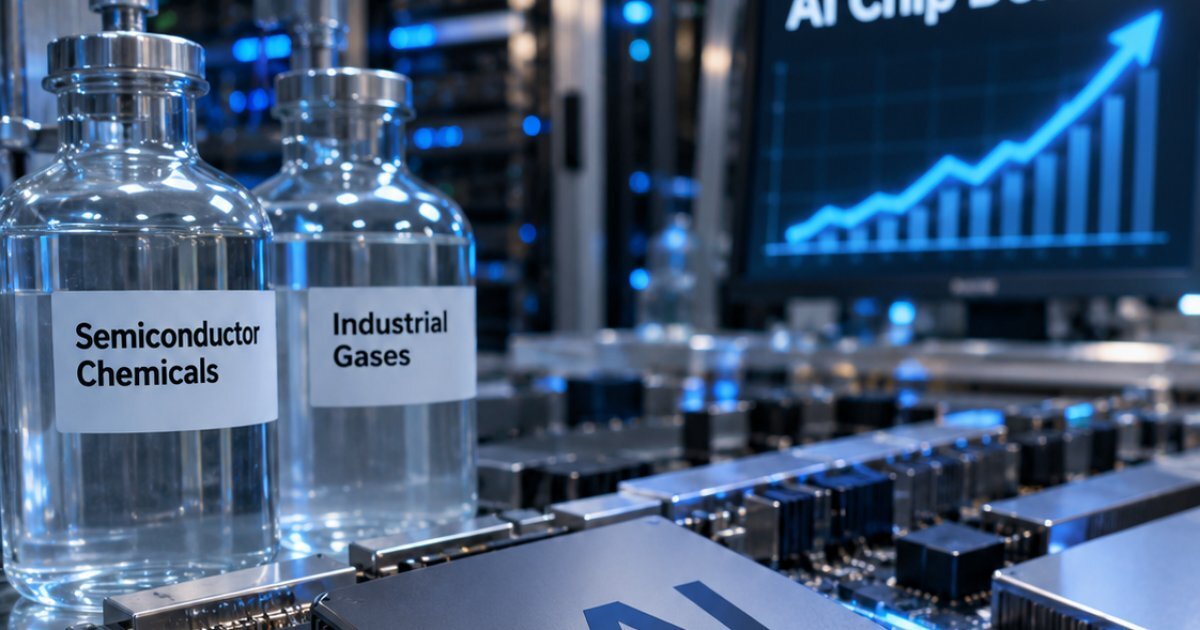
AI chip demand helped drive third-quarter growth at chemical and industrial gas companies as semiconductor manufacturers expanded capacity for artificial intelligence systems. The trend is widening the financial impact of the AI boom beyond chip designers and manufacturers to suppliers of the gases and specialty chemicals used inside semiconductor factories.
Key Takeaways
- Syensqo CEO Mike Radossich expects semiconductor sales in the second half of 2026 to improve 25% over the first half.
- Linde committed $1 billion in July to supply a major semiconductor manufacturing facility in Arizona.
- Air Liquide agreed to acquire South Korea's DIG Airgas for €2.85 billion in August.

Syensqo, Linde and Air Liquide all reported signs of stronger semiconductor-related business, while Solvay announced plans to expand production of an ultra-pure chemical in Taiwan. The companies do not make AI processors themselves. They supply materials that chip manufacturers need as AI servers require more silicon and the industry invests in new production capacity, according to Reuters reporting published by Yahoo Finance.
Why AI chip demand is reaching chemical suppliers
AI servers are becoming the semiconductor industry’s main growth engine, Reuters reported. Compared with traditional computing infrastructure, AI chip demand is helping these systems require far more silicon, pushing chip manufacturers to add production capacity and invest in more advanced manufacturing.
That expansion, driven by AI chip demand, creates business for companies further down the semiconductor supply chain. Linde and Air Liquide supply industrial gases, while Syensqo and Solvay produce specialty chemicals. Their materials are used in semiconductor production, where manufacturing processes increasingly require extremely high levels of purity.
Purity matters because chip fabrication depends on tightly controlled materials. A supplier’s role is therefore tied to the manufacturing process even though its name may never appear on the finished processor. As AI chip demand increases production at semiconductor factories, these suppliers can benefit from new projects and higher operating activity.
Syensqo sees stronger semiconductor materials sales
Belgian specialty chemicals company Syensqo beat third-quarter expectations on Nov. 5, with semiconductor manufacturers continuing to support its materials business. The company did not disclose a specific semiconductor revenue figure in the Reuters report, but CEO Mike Radossich gave a positive outlook for the rest of 2026.
“We’ll probably see a 25% second-half improvement in our sales in semiconductors over the first half,” Radossich told journalists. That is a company outlook, rather than a completed result, and it compares expected semiconductor sales in the second half of the year with the first half.
The statement shows why advanced semiconductor materials are becoming a significant part of the AI supply chain. When chipmakers expand production or move toward more demanding processes, material suppliers may need to support those changes with products that meet stricter purity requirements.
Newsletter
Get the VaidikX AI Brief
The week's biggest AI, Big Tech and startup news, explained in 5 minutes. Free, every week.
Linde and Air Liquide invest around chip factories
Industrial gas companies Linde and Air Liquide also reported forecast-beating third-quarter results last week, helped by double-digit sales growth in electronics businesses that supply semiconductor manufacturers. The Reuters report did not provide their total quarterly revenue figures or separate exact growth rates for those electronics divisions.
Linde has made a large commitment tied to US semiconductor production. In July, the company committed $1 billion to supply a major semiconductor manufacturing facility in Arizona. The agreement gives Linde direct exposure to the construction and operation of a large chipmaking project, although the source does not identify the facility or provide details about its production schedule.
Air Liquide is expanding its semiconductor-related investments as well. The company said its electronics investments during the first nine months of 2026 nearly doubled compared with its spending across all of 2025. In August, Air Liquide agreed to acquire South Korea’s DIG Airgas for €2.85 billion, and it recently announced a new plant in Taiwan.
Air Liquide also committed nearly €200 million to support an SK hynix semiconductor project. Together, those moves show how suppliers are placing facilities and capital near major chipmaking centers in Asia, while Linde’s Arizona commitment illustrates the same pattern in the United States.
Solvay expands ultra-pure chemical production in Taiwan
Solvay is another example of AI chip demand creating opportunities for materials producers. The company said in September that it would double capacity at an ultra-pure hydrogen peroxide plant in Taiwan’s Hsinchu Science Park.
Hsinchu is also where Taiwan Semiconductor Manufacturing Co. is expanding production of 3-nanometer chips. A nanometer is a unit used to describe a chip manufacturing process, and the source connects the site expansion with the need for increasingly pure materials in advanced semiconductor production.
Solvay spun off Syensqo in 2023, so the two companies are separate businesses but remain part of the same broader chemicals story. Their semiconductor exposure reflects the importance of materials that support chip fabrication rather than the design or branding of the final AI processor.
What AI chip demand means for the semiconductor supply chain
The immediate effect of AI chip demand is a broader investment cycle. Semiconductor manufacturers are adding capacity to meet demand for AI chips, and suppliers are responding with new plants, expanded production and long-term commitments connected to individual chip projects.
For US readers, the clearest disclosed example of AI chip demand is Linde’s $1 billion Arizona commitment. It indicates that the growth associated with AI chips is reaching US industrial projects, not only technology companies headquartered in the country. Air Liquide’s Taiwan plant and SK hynix commitment, along with Solvay’s Hsinchu expansion, show that Asia remains central to the manufacturing network described in the report.
There are limits to what the third-quarter results establish. The source reports favorable performance and company investment plans, but it does not provide a complete breakdown of revenue from AI-related customers, identify which contracts are dedicated specifically to AI processors, or quantify how much of each supplier’s growth comes from AI rather than broader semiconductor demand.
It is also not clear from the report how long the current pace of investment will continue. The companies are making commitments based on strong demand, while Syensqo’s 25% outlook is explicitly a forecast. For now, the key takeaway is that AI chip demand is supporting an expanding network of materials and gas suppliers whose products are essential to advanced semiconductor manufacturing.
Source: Yahoo Finance
Get the VaidikX AI Brief, free
More from VaidikX