

In this article
- Why Elon Musk is challenging India’s regulatory process
- Starlink India remains prepared but has no confirmed launch date
- How the Starlink vs Jio competition is taking shape
- What satellite broadband could change for Indian users
- The unresolved cost and availability questions
- What happens next for Starlink in India
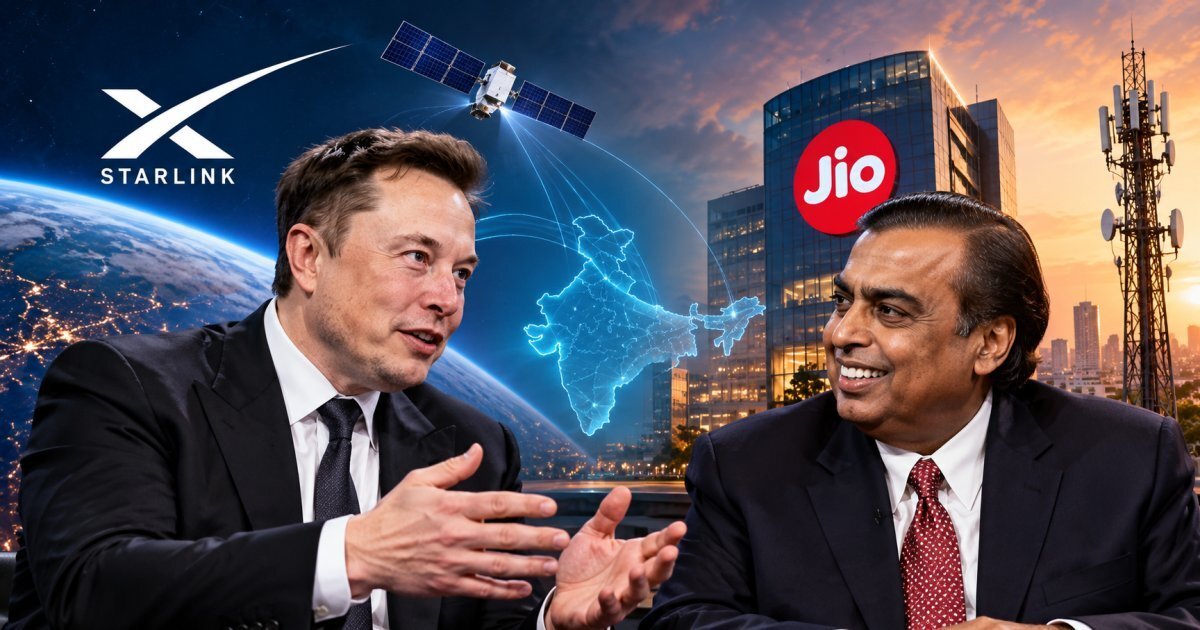
Starlink India has yet to begin commercial service, and Elon Musk is publicly questioning whether influential Indian business interests are delaying SpaceX’s entry into the country. Musk suggested that unnamed “oligarchs” were protecting a “monopolistic chokehold,” then directly asked whether Reliance Industries chairperson Mukesh Ambani was “the real boss of India?”
The dispute matters because Starlink is seeking access to a market with more than a billion internet subscribers, while Reliance Jio and Bharti Airtel are also preparing satellite broadband offerings. India’s Ministry of Communications rejects the suggestion that Starlink is being singled out, saying Starlink and two other licensed satellite operators are at broadly the same regulatory stage.
TechCrunch reported the comments and the government’s response on October 8, 2026. Starlink has announced neither a new consumer plan nor a launch date. The immediate question is how much longer the company must wait before it can offer service commercially.
Why Elon Musk is challenging India’s regulatory process
Musk’s criticism followed years of effort by SpaceX to bring Starlink to India. According to the report, the company has spent more than five years seeking entry, secured key regulatory approvals, formed partnerships with Reliance Jio and Bharti Airtel, and created a local operating team.
On Wednesday, Musk accused unnamed business interests of blocking Starlink to preserve their position in India’s connectivity market. He called the alleged obstruction a “crime against the people of India” and argued that Starlink could provide affordable, high-speed internet to people who currently lack reliable access. The report does not provide evidence supporting Musk’s allegation, and Musk did not identify the businesses he was referring to in that initial accusation.
Hours later, India’s Ministry of Communications said the country’s satellite communications rules are “fair and non-discriminatory.” The ministry stated that Starlink, along with two other licensed satellite operators, is at broadly the same point in the regulatory process. All three companies are undergoing security assessments, which must be completed before they can apply for spectrum.
Spectrum means the radio frequencies used to transmit signals between satellites, ground stations and customer equipment. Without the required spectrum and completed security reviews, a company cannot move from preparation to full commercial operations.
Starlink India remains prepared but has no confirmed launch date
Starlink’s position is that it has already done substantial work to meet India’s requirements. The company said it has more than 20 gateway sites and hundreds of antennas on the ground in the country. Gateway sites are ground stations that connect Starlink’s satellites to the wider internet, allowing data to move between the satellite network and online services.
Starlink also said it has adapted its operations to meet India’s regulatory, security and data-sovereignty requirements. Data sovereignty refers to rules governing where data is handled and which country’s laws apply to it. The company has positioned its network as a complement to India’s existing terrestrial telecom infrastructure rather than a replacement for mobile and fixed-line networks.
Lauren Dreyer, Starlink’s vice president of business operations, reiterated the company’s commitment at India Mobile Congress in New Delhi. “We stand ready to serve India,” Dreyer said, adding that Starlink wants to support Prime Minister Narendra Modi’s goal of universal connectivity across the country.
Those preparations do not establish when service will begin. The timing of Starlink’s Indian launch remains unclear, and the source does not report final consumer pricing, equipment costs or a confirmed commercial availability date.
How the Starlink vs Jio competition is taking shape
The dispute sits within a wider contest over satellite internet in India. Reliance Jio and Bharti Airtel, the country’s two largest telecom operators, are pursuing their own satellite services even though both have agreed to distribute Starlink in India.
Jio is working with satellite operator SES on satellite broadband. Airtel is a major backer of Eutelsat OneWeb, another licensed satellite operator in India. The market therefore has several potential providers with different commercial relationships: SpaceX brings its own satellite network, Jio is working with SES, and Airtel is tied to OneWeb.
The companies have also disagreed over how satellite spectrum should be assigned. Starlink supported administrative allocation, while Reliance Jio argued that spectrum should be auctioned. An auction could have made entry more expensive for Starlink and other satellite operators. India ultimately chose the administrative approach preferred by Starlink.
That decision did not remove the remaining requirements. Security assessments still need to be completed, and companies must meet the conditions governing commercial operations before they can request spectrum and start service.
What satellite broadband could change for Indian users
Satellite broadband can reach locations where terrestrial networks are difficult or costly to build. Instead of relying entirely on a nearby mobile tower, fiber connection or cable network, a customer terminal communicates with satellites overhead. The satellites then connect through gateway sites to the internet.
For users in remote or poorly connected areas, that architecture could create another route to online access. Starlink says this is the role it wants to play in India: extending connectivity while working alongside existing telecom networks. That is a claim about its intended contribution, not proof that service is currently available to Indian customers.
For example, a hypothetical village outside the practical reach of a fiber rollout could use a satellite terminal to connect to the internet if Starlink receives the necessary permissions, the equipment is available and the local service plan supports that location. The example illustrates the potential advantage, but it does not confirm that Starlink has begun serving such communities in India.
The unresolved cost and availability questions
Satellite internet’s usefulness will depend on more than regulatory approval. Indian customers will need compatible equipment, a service subscription and a clear understanding of where the network is actually available. The source does not state Starlink’s final Indian hardware price, monthly subscription price or operating conditions for customers.
Affordability is especially important because Musk himself has argued that Starlink must offer affordable, high-speed access to attract Indian users. A network can cover a wide geographic area and still remain out of reach if the equipment or subscription is too expensive for the intended customers. The report provides no verified Indian pricing with which to judge that trade-off.
Starlink’s position is also being tested by local competition. Jio and Airtel already have established customer relationships and telecom infrastructure, while their satellite partnerships could give Indian users alternatives if those services reach commercial operation. It is not yet clear how the providers will differ in pricing, coverage or performance.
What happens next for Starlink in India
The next concrete steps are regulatory rather than promotional. Starlink and the other satellite operators must complete security assessments, meet India’s operating requirements and obtain the permissions needed to seek spectrum. Until that process is complete, Musk’s public accusations and Starlink’s preparations do not amount to a commercial launch.
India’s government says the process is being applied evenly. Musk argues that Starlink has faced unnecessary obstruction and has specifically raised questions about Ambani’s influence. Those positions remain in conflict, and the source does not independently establish that Reliance or any other company blocked Starlink’s entry.
For Indian consumers, the practical takeaway is limited but significant: Starlink may become another satellite internet option, particularly for places underserved by terrestrial networks, yet there is still no confirmed launch date or verified Indian price. Its eventual impact will depend on whether regulatory approval is completed and whether the service can match its promise of broad access with pricing and availability that ordinary users can afford.