In this article
Google announced Gemini 4 Hydrogen on Nov. 12, making the model available globally for coding, everyday assistance and agentic workflows. In its announcement of Gemini 4 Hydrogen, the company describes a faster, lower-cost model that can handle routine execution on its own or work alongside Gemini 4 Carbon and Gemini 4 Argon.
Key Takeaways
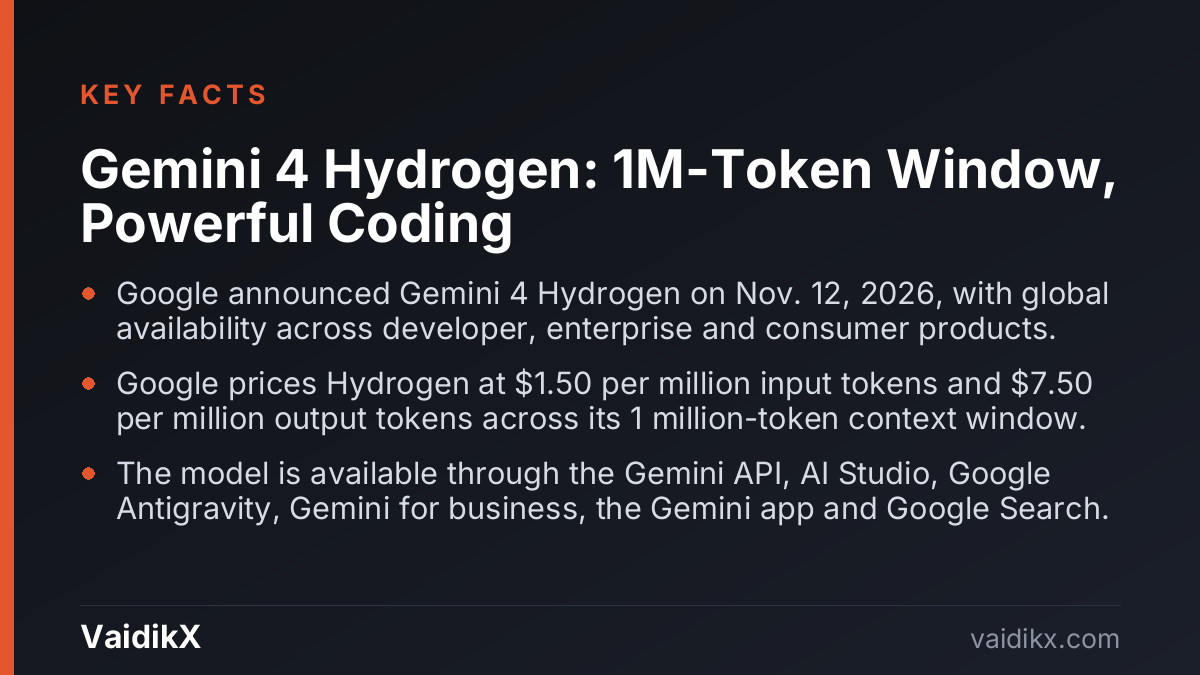
- Google announced Gemini 4 Hydrogen on Nov. 12, 2026, with global availability across developer, enterprise and consumer products.
- Google prices Hydrogen at $1.50 per million input tokens and $7.50 per million output tokens across its 1 million-token context window.
- The model is available through the Gemini API, AI Studio, Google Antigravity, Gemini for business, the Gemini app and Google Search.
Hydrogen is built for quick execution rather than the deepest available reasoning. That distinction matters for US developers and businesses choosing models for software work, research and automation: Gemini 4 Hydrogen can handle routine tasks independently or work alongside Google’s larger Gemini 4 Carbon and Gemini 4 Argon models in a multi-model system.
The announcement comes from Koray Kavukcuoglu, Google’s senior vice president of Google DeepMind and chief AI architect. The performance, safety and pricing figures below are Google’s reported results and claims.
What is new in Gemini 4 Hydrogen
At the default high thinking level, Gemini 4 Hydrogen scored 51 on the Artificial Analysis Intelligence Index, ahead of Gemini 4 Argon’s score of 50. At the highest xhigh setting, it reached 54. Google also says Hydrogen often completes tasks faster than comparable models.
The model has a 1 million-token context window, allowing it to process a large volume of text or other input in one session. Google lists a flat price of $1.50 per million input tokens and $7.50 per million output tokens across that context window.
Users can choose among four thinking levels—low, medium, high and xhigh. The settings trade reasoning depth against response time and cost, with high as the default. Google’s testing indicates that Hydrogen often completes work sooner and produces fewer output tokens across those settings.
How Hydrogen fits into coding and agent workflows
Google’s main use case is execution. Carbon or Argon can handle architectural choices and difficult bug investigations, while Hydrogen writes code, runs tests and checks the result. That division uses deeper reasoning where decisions require it and a quicker model for repeated implementation work.
Google Antigravity includes an Orchestrator that can switch models during a session instead of keeping one model assigned from start to finish. In Google’s Terminal-Bench 4.0 results, Orchestrator delivered task-success rates close to Carbon while using 24% less quota on average and finishing 19% faster.
Another setup has Carbon coordinating while Hydrogen runs worker and verifier agents in isolated workspaces. Those agents can build, test and review changes in parallel. The source does not provide an independent evaluation of these workflows.
For teams moving from Gemini 3.8 Flash, Google’s comparison found that Hydrogen completed tasks 2.5 times faster at the high setting and lifted its Terminal-Bench 4.1 score from 18.2% to 57%. The company also reports more than a fivefold reduction in fabricated claims and better handling of failed tool calls or empty search results.
Newsletter
Get the VaidikX AI Brief
The week's biggest AI, Big Tech and startup news, explained in 5 minutes. Free, every week.
Developer, enterprise and multimodal capabilities
Gemini 4 Hydrogen is aimed at iterative repository coding, debugging, codebase questions and focused edits that leave unrelated files alone. It can read files and run search requests in batches rather than reviewing each file sequentially. In early partner tests covering graph, SQL and data-heavy enterprise workflows, Google reports speed gains of two to 2.8 times and token-use reductions of 12% to 23% compared with Gemini 3.8 Flash.
The model also supports longer agent tasks, including research, data analysis and broad codebase navigation. Google’s reported results include 58.8% on HLE-Diamond, 52.3% on Vals Tax Agent Bench, 55.8% on Vals Legal Research Bench and a No. 5 ranking on Agent Arena. These are reported benchmark results, not independent VaidikX testing.
Its multimodal design works with dense PDFs, spreadsheets, charts, audio and recorded video. Google reports that it can accept up to 1 million input tokens and produce up to 1 million output tokens for cited reports and structured deliverables. It also reports scores of 53.4% on the Multimodal Knowledge Agent benchmark and 71.6% on Agents’ Last Exam v1.1.
Company examples include an e-commerce storefront, a Google Slides presentation, an animated pixel canvas built from Google Sheets and interactive visual projects. Google also reports that Gemini in Google Sheets can create financial models that respond to forecasting scenarios more than 30% faster than earlier models in Sheets canvas.
Where US developers and businesses can access it
Developers can use Gemini 4 Hydrogen through the Gemini API in Google AI Studio and Android Studio. Access is also available in AI Studio and for paid Google AI Pro and Ultra subscribers in Google Antigravity.
Businesses can deploy Hydrogen through Gemini for business, either through the API or a model-selection menu, and through Google Antigravity and Gemini in Google Sheets for eligible business subscriptions. Consumers can select it in the Gemini app and use it in Google Search. Gemini in Google Sheets is available to Google AI Pro and Ultra subscribers.
This distribution gives US organizations several ways to use one model family, from API-based software products to workplace applications. The decision therefore depends on the thinking level, token cost, latency and whether a task belongs with Hydrogen or a larger model.
Developers are making those choices amid a steady flow of competing releases, including new AI models aimed at coding and reasoning. Google’s approach uses Antigravity to make model changes part of the workflow rather than treating one model as suitable for every task.
Gemini 4 Hydrogen’s safety claims and remaining questions
Hydrogen carries the latest Gemini 4 safety and security measures, according to the company, combining training with real-time safeguards. Compared with Gemini 3.8 Flash, Google’s tests report up to 81% less overreach in agentic tasks, up to 79% less under-service and a 12-fold reduction in misaligned actions and task shortcutting across tool-use and coding evaluations.
The company’s internal agent-honesty evaluation gave Hydrogen a reported honesty rate of 96.7%. Google also says the model was up to twice as unlikely to bypass permission boundaries when tasks were impossible or blocked. Its testing found 99.9% chain-of-thought legibility across more than 200,000 audited turns and more than 2.3 times greater resilience against indirect prompt injection on the Gray Swan IPI benchmark.
These figures describe Google’s testing and do not show how Hydrogen will perform in every production environment. Organizations still need to test it with their own tools and data, identify the thinking level that delivers acceptable results and decide when a higher-capability model justifies extra cost or latency.
For now, Gemini 4 Hydrogen is Google’s broadly distributed execution model for coding, agents and everyday AI tasks. Its practical proposition combines wide access, adjustable reasoning levels, a large context window and pricing intended for repeated use, while the company’s benchmark claims still require comparison with real-world evaluations.
Source: Google
Get the VaidikX AI Brief, free
More from VaidikX