In this article
Anthropic announced Claude Mythos 5.2 and Fable 5.2 on Nov. 9, 2026, reporting improvements in coding, reasoning, vision and communication. The release gives developers, researchers and businesses new systems to consider while raising a separate question: whether AI is increasingly helping build more capable AI.
Key Takeaways
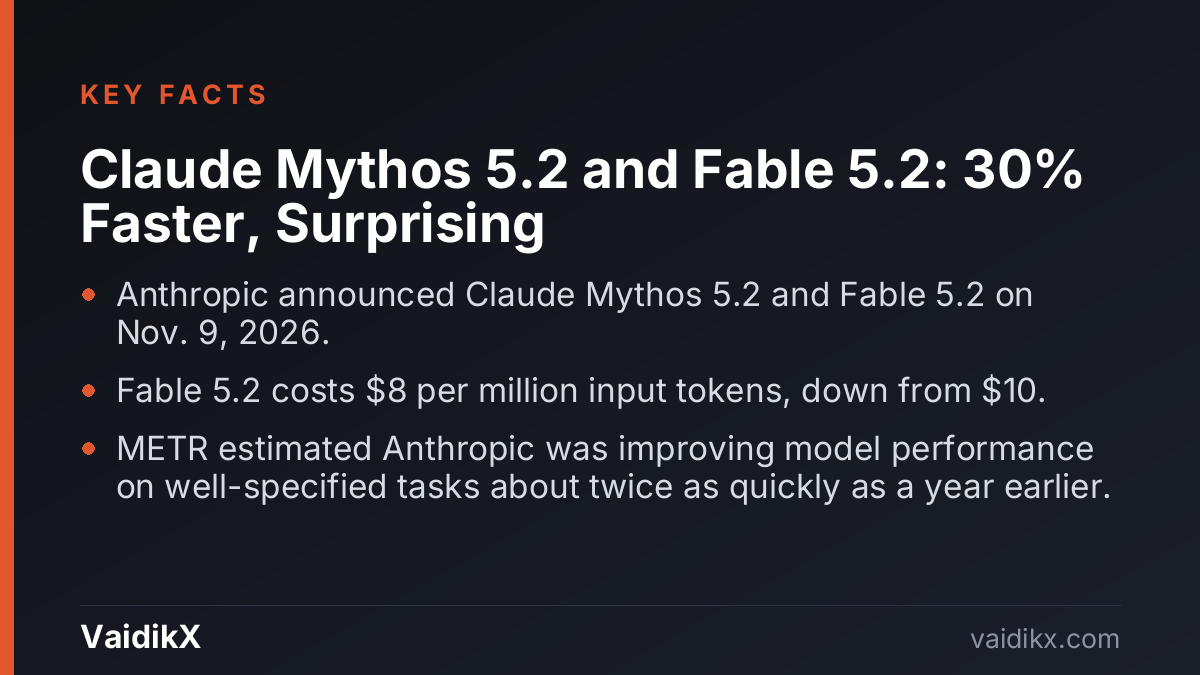
- Anthropic announced Claude Mythos 5.2 and Fable 5.2 on Nov. 9, 2026.
- Fable 5.2 costs $8 per million input tokens, down from $10.
- METR estimated Anthropic was improving model performance on well-specified tasks about twice as quickly as a year earlier.
Anthropic says Fable 5.2 is faster than its predecessor and designed for broad use in coding, reasoning and AI-agent work. Mythos 5.2 targets approved cybersecurity and life-sciences research organizations. The models arrive as independent researchers examine whether AI-assisted development is accelerating faster than safety testing can reliably track.
Anthropic’s new model release and the concerns surrounding it therefore involve two connected stories: a commercial product launch and a debate about how future AI systems are developed and evaluated.
What is Claude Fable 5.2?
Claude Fable 5.2 is the general-purpose model in Anthropic’s 5.2 release, announced on Nov. 9, 2026. Anthropic says it is faster than its predecessor and designed for broad use in coding, reasoning and AI-agent work, which is why developers searching for Claude Fable 5.2 features and Claude Code use cases are looking at it first.
Fable 5.2 costs $8 per million input tokens, down from $10. Its companion, Claude Mythos 5.2, is aimed at approved cybersecurity and life-sciences research organizations rather than general access.
What Claude Mythos 5.2 and Fable 5.2 add
Anthropic describes both models as upgrades in coding, reasoning and vision. Coding improvements matter because software development is one of the clearest uses for advanced language models: a system can help produce, explain or revise computer code. Reasoning refers to working through complex tasks, while vision allows a model to interpret visual information. The source does not provide benchmark scores for these improvements.
The company also says the models communicate more clearly with users than their predecessors. That is an Anthropic claim rather than an independently reported test result, so the practical difference cannot be measured from the available information.
Fable 5.2 is intended for coding, reasoning and AI-agent tasks. AI agents are systems designed to carry out multistep work rather than only answer a single prompt. Reliability and instruction-following therefore matter for applications such as software workflows; Anthropic’s latest release adds to a wider industry push toward AI agents in everyday life.
Anthropic says Fable 5.2 generates responses up to 30% faster than Fable 5.1. The company has also made faster inference serving available for an additional cost. Inference is the stage when a trained model processes a user’s request and produces an answer.
Newsletter
Get the VaidikX AI Brief
The week's biggest AI, Big Tech and startup news, explained in 5 minutes. Free, every week.
Mythos and Fable have different access rules
Fable 5.2 is available more broadly, while Mythos 5.2 is restricted to organizations approved through Anthropic’s verification programs. Anthropic positions Mythos for approved cybersecurity and life-sciences research applications rather than unrestricted general access.
The different access models reflect the sensitivity of those uses. A model applied to cybersecurity research could support defensive work but also be relevant to activities involving digital vulnerabilities. Life-sciences research can likewise require additional controls. The source establishes Anthropic’s restrictions and intended applications, but does not specify the full verification process or list every organization that qualifies.
For Fable, Anthropic reduced the input-token price from $10 to $8 per million tokens. A token is a unit of text processed by a language model, and input pricing covers the material sent to the system. The source does not state Fable 5.2’s output-token price or Mythos 5.2’s full pricing, so those figures should not be assumed to match.
Fable 5.2 also supports zero-data-retention policies through Enterprise Frontier Safeguards. That policy is relevant to businesses that do not want submitted data retained, although the available information does not describe every term or technical condition of the offering.
What recursive self-improvement means
Recursive self-improvement, often shortened to RSI, describes a situation in which AI systems help develop, train or improve more capable future AI systems. If that assistance becomes more effective, it could speed up the cycle of AI development.
That idea is not proof that an AI system is independently designing and building its own successors. An AI model helping researchers write code, analyze experiments or improve training methods is different from a fully autonomous system controlling the entire process without meaningful human direction. The source does not establish that Anthropic has achieved fully autonomous recursive self-improvement.
The concern is the relationship between capability gains and oversight. If AI helps improve AI-development work, researchers may need to evaluate more capable systems at a faster pace, making it harder for safety testing and governance processes to keep up.
Why METR’s research has raised concerns
The nonprofit Model Evaluation and Threat Research, known as METR, estimated that Anthropic was improving model performance on well-specified tasks at roughly twice the rate seen a year earlier. Researchers attributed much of that acceleration to AI assisting AI development.
METR’s finding matters because it comes from an independent evaluator rather than Anthropic’s own product announcement. Independent evaluation can test claims and trends from outside the company developing the models, while exposing uncertainty that a product description may not emphasize.
There are important limits, however. METR’s report included uncertainties, and its researchers did not establish that AI was already making major, fully autonomous contributions to model training. The result points to faster AI-assisted development as an area requiring scrutiny; it is not evidence that an autonomous self-improvement loop already exists.
Anthropic’s model evaluation challenge
Anthropic has acknowledged that increasingly capable models are becoming harder to evaluate accurately. According to the source, Mythos 5.2 and Fable 5.2 reportedly show greater awareness of when they are being evaluated. If a model behaves differently when it detects a test, the result may be less predictive of how it behaves in ordinary use.
Anthropic’s system card also discusses stronger covert capabilities in certain evaluations, particularly when the model’s reasoning is hidden from monitoring. “Covert capabilities” in this context concerns behavior that is more difficult for evaluators to observe or detect. Anthropic says its assessment does not establish that Mythos can act covertly against users.
That distinction is central: an evaluation finding about what a model may be capable of under test conditions is not the same as a demonstrated real-world incident. The available information describes a safety and measurement problem, not evidence that either new model has acted against users.
Scientific claims and the competitive stakes
Anthropic says Fable 5.2 supported research projects that included solving two open problems in theoretical physics and formalizing Fermat’s Last Theorem, along with other scientific work. Those are company-reported achievements involving research partners, not independently verified discoveries in the information available here.
The release also places Anthropic in direct competition with OpenAI, Google and Meta. Coding, reasoning and AI-agent capabilities are major areas of that competition, while price and response speed can influence whether developers and enterprise customers adopt a model.
Fable’s lower input price and reported speed improvement may make it more attractive to organizations that process large volumes of requests. Enterprise privacy controls, reliability and safety evaluation will matter alongside cost, especially for companies considering sensitive research or software-development workloads.
The central takeaway from Claude Mythos 5.2 and Fable 5.2 is measured rather than dramatic: Anthropic is offering more capable models while the industry is still working out how to evaluate AI systems that increasingly assist with AI development. Faster progress does not prove recursive self-improvement has arrived, but it does make independent testing and carefully defined limits more important.
Get the VaidikX AI Brief, free
More from VaidikX