In this article
The new US AI chip ban China measure announced Nov. 16 will require licenses for certain advanced artificial intelligence chips and computing equipment sent to five overseas destinations. The US AI chip ban China rule is designed to stop China-headquartered companies from using data centers in third countries to access powerful US-made chips.
Key Takeaways
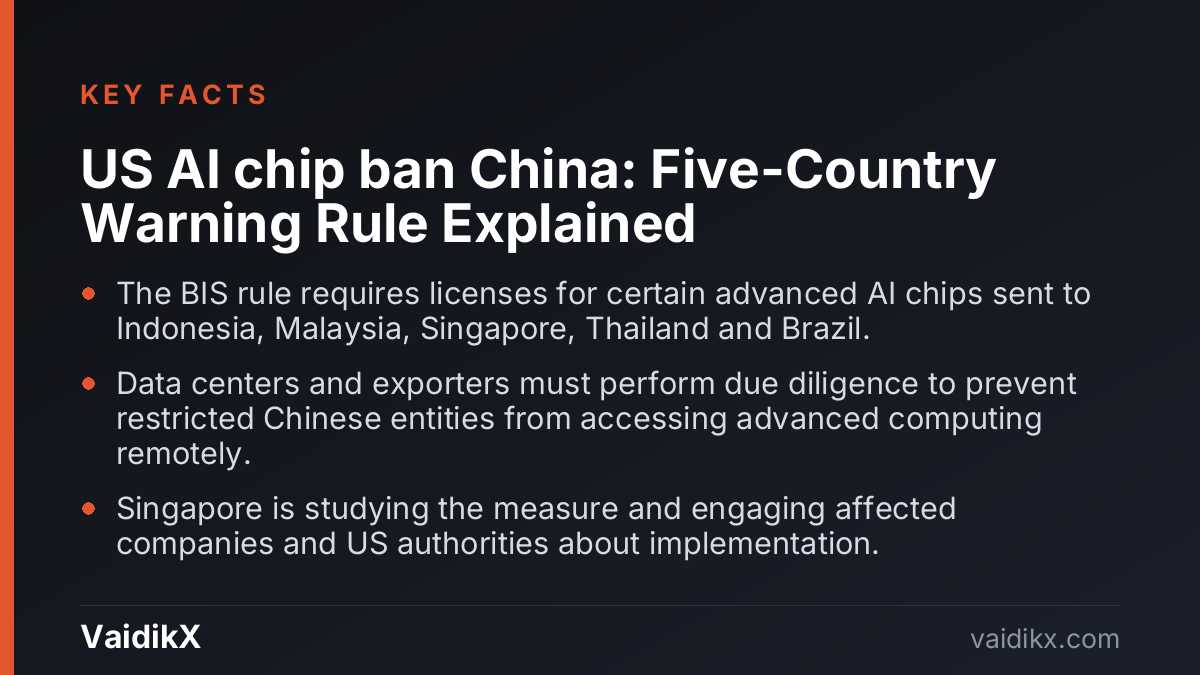
- The BIS rule requires licenses for certain advanced AI chips sent to Indonesia, Malaysia, Singapore, Thailand and Brazil.
- Data centers and exporters must perform due diligence to prevent restricted Chinese entities from accessing advanced computing remotely.
- Singapore is studying the measure and engaging affected companies and US authorities about implementation.
The US AI chip ban China policy affects chip exporters, data-center operators and foreign companies that provide computing capacity to restricted customers. Existing controls generally focused on where chips were shipped and who bought them. This approach also targets how advanced computing power is accessed from abroad. Al Jazeera reported that the measure is aimed especially at data centers in Southeast Asia that can provide large amounts of computing power to Chinese AI developers.
What the US AI chip ban China rule changes
The interim final rule comes from the Commerce Department’s Bureau of Industry and Security, or BIS. It requires an export license for certain advanced AI chips and computing equipment exported, re-exported or transferred to Indonesia, Malaysia, Singapore, Thailand and Brazil.
BIS describes those countries as presenting an “unacceptable risk of diversion” in the Al Jazeera account, while the Commerce Department’s announcement reported by Yahoo News describes them as having a “higher-than-normal risk of diversion.” In practical terms, a shipment to one of these countries will face additional US review even when the immediate customer is not based in China.
The US AI chip ban China rule also covers overseas data centers that provide significant computing power to companies headquartered in China, Macau and other restricted jurisdictions. Its stated purpose is to make it harder for those companies to train AI models with advanced US semiconductors after gaining access through a foreign server rather than importing the chips directly.
How remote access creates an export-control route
An AI chip does not have to be physically delivered to a Chinese company for that company to use its computing power. A data-center operator can install advanced graphics processing units, or GPUs, in another country and rent access to the servers over the internet. The customer then sends software and training workloads to the facility while the hardware remains overseas.
Before this rule, Chinese companies barred from importing the most advanced GPUs could still legally use computing capacity hosted in countries such as Singapore, Malaysia and Thailand, according to Al Jazeera. The US AI chip ban China policy attempts to close that route by placing responsibility on the data center and the companies involved in supplying or transferring the equipment.
The rule calls for “robust due diligence” by data centers, foreign foundries and chip exporters. Those businesses must examine their customers and transactions closely enough to identify whether advanced computing is being made available to restricted entities or diverted to China. The sources do not specify every compliance procedure or the penalties that would apply to each possible violation.
Newsletter
Get the VaidikX AI Brief
The week's biggest AI, Big Tech and startup news, explained in 5 minutes. Free, every week.
Why the US AI chip ban China policy matters for US readers
For US companies, the immediate change is a compliance obligation. Exporters and businesses supplying advanced chips to the 5 named countries may need a license, while data-center operators must scrutinize who is renting computing capacity and what that capacity will support.
The measure also signals that US export controls are expanding beyond traditional sales. A company could be affected even when it does not ship a finished AI system directly to China if its chips, servers or cloud capacity give a restricted Chinese customer access to advanced computing.
Rep. John Moolenaar, chair of the US House Select Committee on China, praised the rule. He said it sends a message that the United States is serious about closing export-control loopholes and argued that America’s most advanced AI chips should not be sold to its “foremost enemy.” His comments represent a political response to the policy, not an independent assessment of how effective the rule will be.
Singapore is reviewing the consequences. Its Ministry of Energy, Trade and Industry and Ministry of Digital Development and Information said the country was studying the measure, speaking with affected companies and engaging US authorities about its scope and implementation. The ministries also said Singapore did not support companies using the country to circumvent or violate other nations’ laws.
What it means for India: analysis, not a confirmed outcome
The US AI chip ban China could create both pressure and opportunity for India, according to analysis published by The Week. The analysis argues that companies seeking data-center locations may look more closely at India as US scrutiny increases around Southeast Asian computing hubs. That is a possibility, not a confirmed investment decision or a government forecast.
The same analysis says India may gain strategic room if China has less access to advanced AI computing, while Indian defense and technology organizations could still face tighter checks and longer licensing processes as Washington increases oversight. The sources do not establish that Indian companies will receive special access to US chips under this rule.
The Week also argues that India will need stronger controls over cloud rentals, data-center customers and foreign corporate relationships if it wants to be viewed as a trusted location for advanced computing. That is analysis from The Week, not a requirement announced in the BIS rule.
What remains uncertain about the new restrictions
The US AI chip ban China rule is an interim final rule, and the Commerce Department said it will take effect upon publication in the Federal Register. The sources do not provide a complete list of affected chip models, a timetable for every license decision or a detailed explanation of how data centers must verify the ultimate users of their computing capacity.
It is also not clear from the available reporting how the rule will affect legitimate businesses in the five named countries that use advanced chips for their own work. Singapore’s request for clarity shows why implementation details matter to companies operating inside the new licensing framework.
The core policy direction is clear: the United States wants export controls to follow access to advanced AI computing, not only the physical movement of chips. The US AI chip ban China therefore reaches into cloud services and overseas data-center operations, making compliance a shared responsibility across the supply chain.
More stories from VaidikX
- Global AI stock sell-off and tighter AI rules
- Terafab chip engineers hiring and Tesla and SpaceX chip plans
Source: Al Jazeera, Yahoo News, @theweek
Get the VaidikX AI Brief, free
More from VaidikX