
In this article
- What the Anthropic IPO prospectus reveals
- Claude’s growth comes with a sharply higher operating bill
- Anthropic is presenting AI as a broad economic platform
- Amazon and Google are central to Anthropic’s infrastructure model
- Why the Anthropic IPO prospectus matters to AI investors
- The Anthropic IPO prospectus also details risks from increasingly capable models
- What remains uncertain before an Anthropic IPO
- Anthropic IPO prospectus: frequently asked questions
- What does the Anthropic IPO prospectus reveal?
- Why is Anthropic’s net loss $42 billion?
- How much does Anthropic spend on computing?
- Has Anthropic set an IPO date?
- What role do Amazon and Google play?
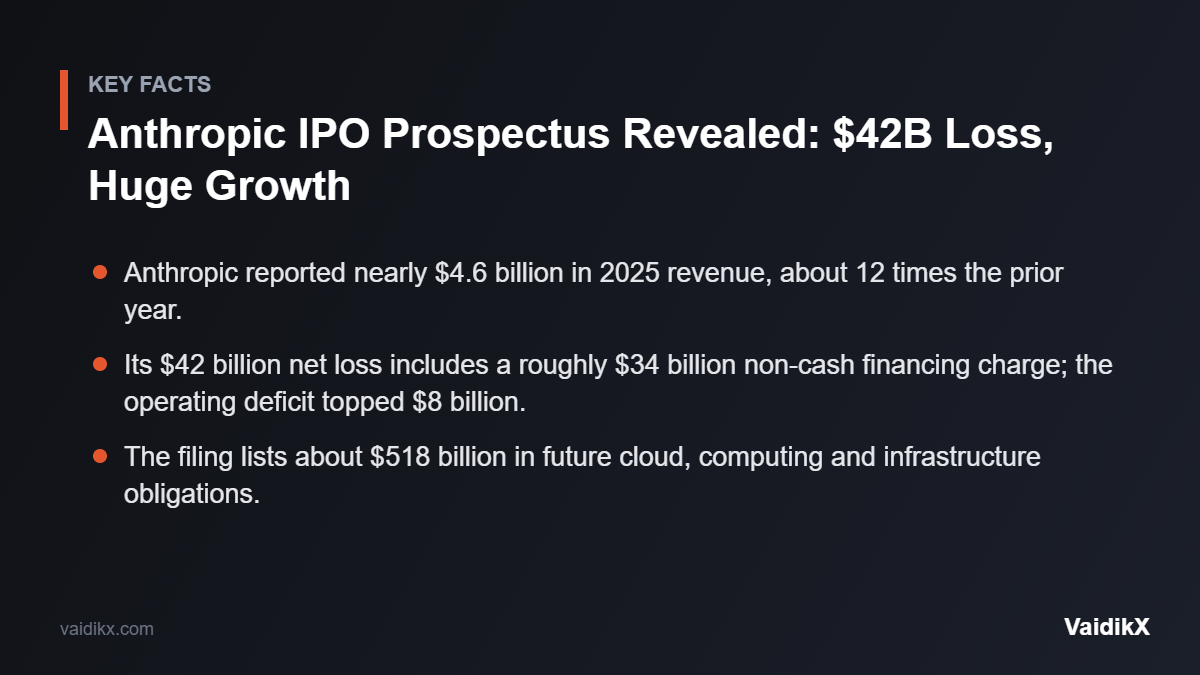
The Anthropic IPO prospectus describes a company with nearly $4.6 billion in 2025 revenue, a reported $42 billion net loss and roughly $518 billion in future cloud, computing and infrastructure obligations. Those figures make the possible listing a test of whether frontier AI revenue can eventually support the cost of building and running advanced models.
Key Takeaways
- Anthropic reported nearly $4.6 billion in 2025 revenue, about 12 times the prior year.
- Its $42 billion net loss includes a roughly $34 billion non-cash financing charge; the operating deficit topped $8 billion.
- The filing lists about $518 billion in future cloud, computing and infrastructure obligations.
The filing does not set an IPO date, share count or offering price. It instead gives investors a view of a possible public offering and the financial demands behind Claude. This report on Anthropic’s prospectus describes the figures and risks disclosed in the filing.
What the Anthropic IPO prospectus reveals
Sales reached almost $4.6 billion in 2025, about twelve times the amount recorded a year earlier. Claude and demand from business users were major parts of that increase.
The $42 billion loss needs to be read alongside a large non-cash accounting item. About $34 billion was tied to the estimated value of financing that might later convert into company shares. That accounting treatment is not equivalent to $34 billion leaving the business for day-to-day operations.
After relevant write-downs were excluded, the operating deficit exceeded $8 billion. The two measures answer different questions: net income reflects the financing-related charge, while operating results show the shortfall produced by running the company.
Claude’s growth comes with a sharply higher operating bill
Operating expenses climbed to $12.65 billion in 2025. Computing and infrastructure absorbed about $7.33 billion, making that category the largest part of the annual bill.
That amount was more than three times the comparable 2024 figure. Model training uses substantial capacity, and serving responses to customers creates continuing demand for processors, storage and cloud services. As usage expands, sales and delivery costs can rise together.
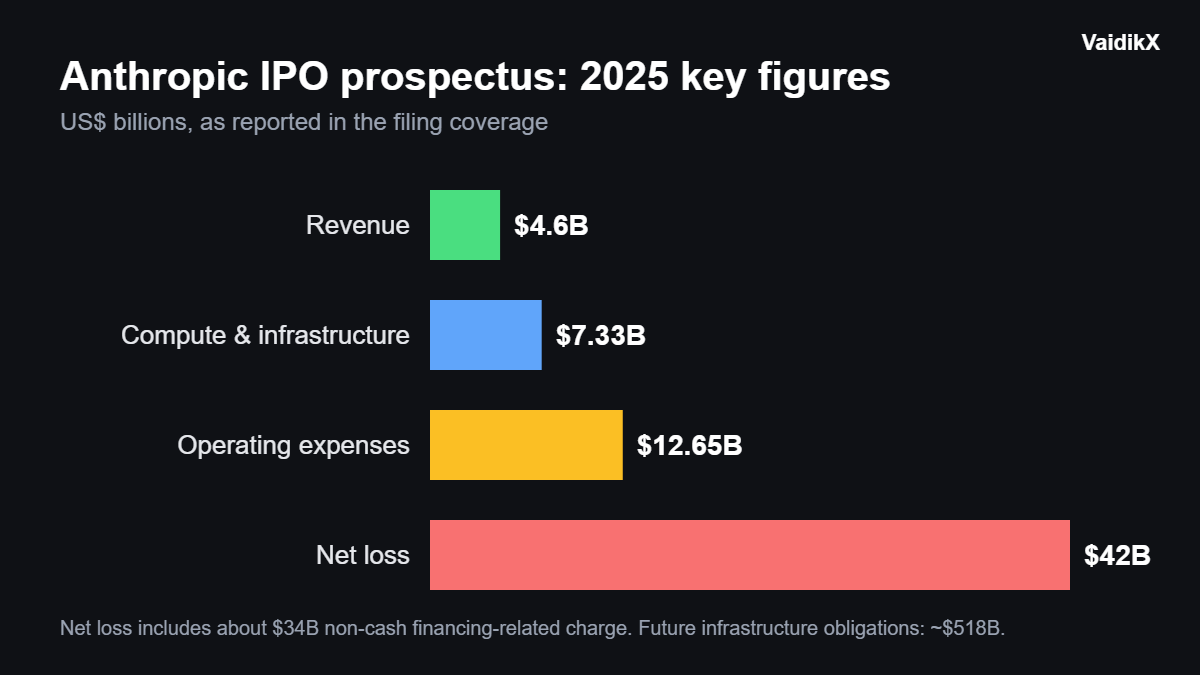
Future commitments add another layer. The filing lists about $518 billion tied to cloud, computing and infrastructure. The figure refers to obligations expected to support the company’s plans; it does not mean that the entire sum has already been paid or consumed.
Newsletter
Get the VaidikX AI Brief
The week's biggest AI, Big Tech and startup news, explained in 5 minutes. Free, every week.
Anthropic is presenting AI as a broad economic platform
The document presents advanced AI as something larger than a standard software subscription. It places the technology alongside earlier shifts such as industrialisation, electricity and the internet.
That argument supports the company’s effort to secure unusually large amounts of computing capacity. Claude is the current commercial base, while the broader strategy assumes that capable AI could change many areas of the economy. That is a corporate forecast, not proof that the predicted outcome will occur.
Investors reading the Anthropic IPO prospectus therefore face a basic financial question: can sales outpace the cost of training, operating and improving the models? Rapid customer adoption does not guarantee durable profit if each increase in use brings an equally large or larger expense.
Amazon and Google are central to Anthropic’s infrastructure model
Cloud access and financing are closely linked to the company’s partnerships. Amazon and Google were early strategic backers, invested billions of dollars and supplied infrastructure for developing and running Claude.
Those arrangements provide access to resources that would be difficult to assemble independently. They also show the dependence of frontier AI companies on a small group of very large technology suppliers. The size and timing of future infrastructure commitments will be affected by the price and availability of that capacity.
Customer concentration is another concern. The company said two customers supplied nearly one-quarter of the prior year’s revenue. Several large accounts, it warned, do not have long-term commitments and could reduce or stop their spending.
Why the Anthropic IPO prospectus matters to AI investors
A confidential draft Form S-1 was submitted to the US Securities and Exchange Commission in June 2026, according to the reported coverage. That step allows the company to continue toward a public offering while the SEC reviews the filing, but it does not guarantee that a listing will proceed.
The reported prospectus coverage puts a possible valuation above $2 trillion. That is more than twice the estimated $965 billion valuation from May. Neither number is a final market value: the eventual price would depend on the offering process and market conditions.
A listing would give investors another detailed set of disclosures for comparing large AI businesses. The source report also says OpenAI confidentially filed for an IPO in June. That places the possible Anthropic offering within a wider move by major AI laboratories toward public markets. OpenAI is also widening its product line, as seen with its new Dots AI agents.
The Anthropic IPO prospectus also details risks from increasingly capable models
Reported disclosures describe possible problems from model behavior that is difficult to predict, including manipulation, blackmail and other harmful conduct. They also address risks arising from the company’s own research and deployment work.
Dario Amodei, Anthropic’s chief executive, has publicly said that the industry should move more slowly when releasing new capabilities because powerful systems may develop faster than society can manage. The company nevertheless continues to build and launch models while competing with OpenAI, Google, Meta and xAI.
Controlled research has examined behaviors such as code sabotage, help with fraud and information manipulation. Those findings describe scenarios identified in testing. They are not evidence that ordinary customers have used Anthropic products to carry out those actions. Similar questions about trust and control are emerging elsewhere in the industry, including around Apple’s Mac AI agent and user data access.
What remains uncertain before an Anthropic IPO
More disclosure in the Anthropic IPO prospectus does not settle the central business questions. Revenue must continue to grow, dependence on a few accounts must fall, and model development must become more efficient if the company is to reach sustainable profitability.
The $518 billion obligation figure also needs careful interpretation. Investors will have to separate signed or anticipated commitments from current expenses and cash generation. The company reported $20.28 billion in cash, equivalents and short-term investments at December 31, but that balance alone does not show how long its expansion plans can be funded.
Anthropic has not completed a public offering, and the supplied source does not establish a final date, deal size or valuation. The Anthropic IPO prospectus is most useful as a picture of the trade-off: Claude is producing unusually fast sales growth, while the computing and cloud capacity required to sustain it carries an extraordinary price.
Anthropic IPO prospectus: frequently asked questions
What does the Anthropic IPO prospectus reveal?
It shows nearly $4.6 billion in 2025 revenue, a reported $42 billion net loss and about $518 billion in future cloud, computing and infrastructure obligations.
Why is Anthropic’s net loss $42 billion?
About $34 billion of the loss is a non-cash accounting charge tied to financing that could later convert into shares. Excluding relevant write-downs, the operating deficit was above $8 billion.
How much does Anthropic spend on computing?
Operating expenses reached $12.65 billion in 2025, with computing and infrastructure taking about $7.33 billion, more than three times the 2024 figure.
Has Anthropic set an IPO date?
No. A confidential draft Form S-1 was reportedly submitted to the SEC in June 2026, but no IPO date, share count, offering price or final valuation has been set.
What role do Amazon and Google play?
Amazon and Google were early strategic backers that invested billions of dollars and supply much of the infrastructure used to develop and run Claude.
More from VaidikX