
OpenAI GPT-6 Astra Explained: Features, Plans, Benefits and What’s New
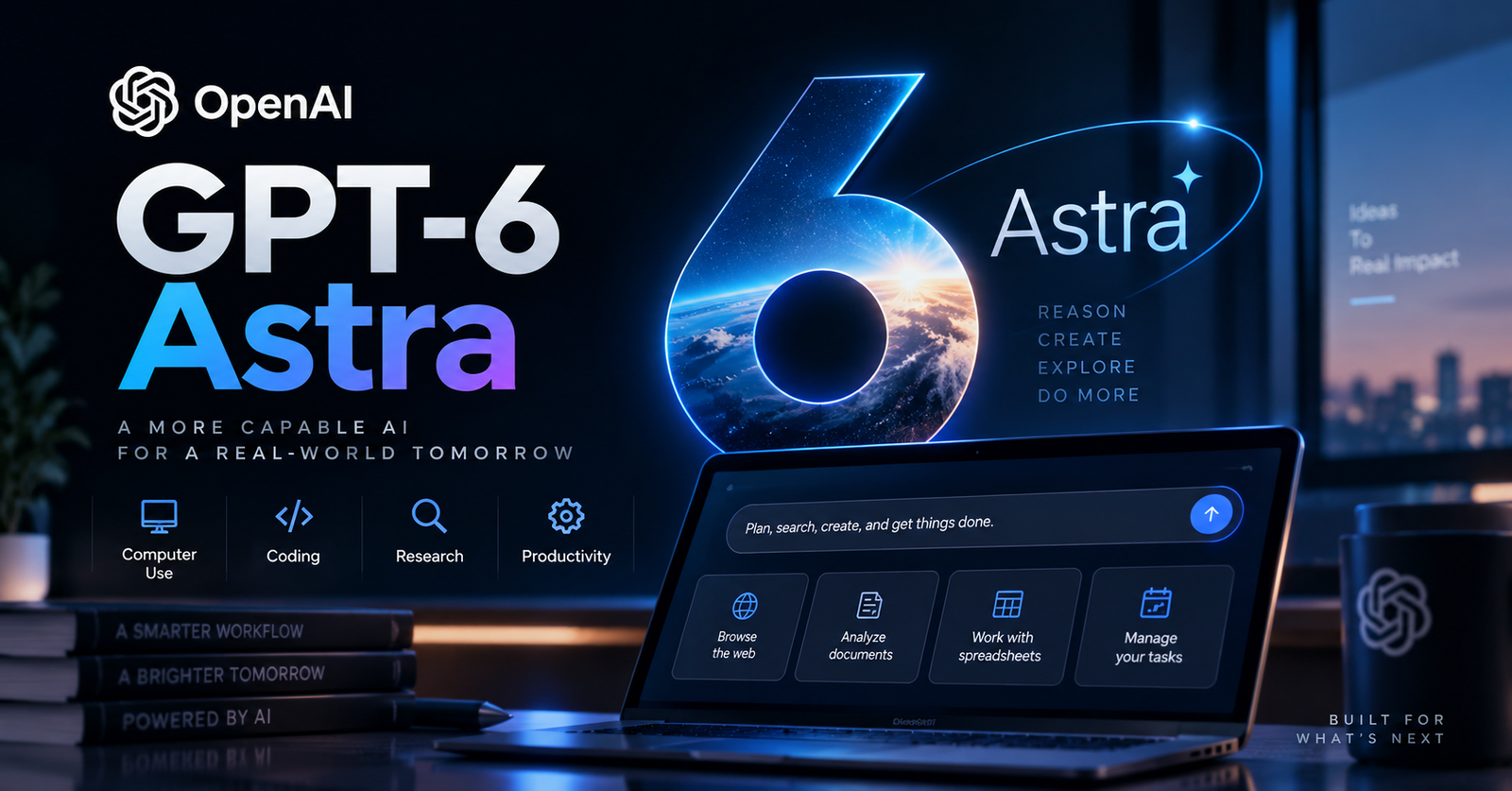
OpenAI has introduced GPT-6 Astra, its latest AI model designed to handle more advanced reasoning, coding, research and computer-based tasks. The company describes Astra as its most capable and aligned model yet, with improvements aimed at complex professional workflows and real-world computer use.
Unlike earlier AI models that were primarily used to generate text, answer questions or assist with coding, Astra is designed to work more directly with computers, browsers and multi-step tasks.
Here’s what GPT-6 Astra brings to ChatGPT and the wider AI ecosystem.
What is GPT-6 Astra?
GPT-6 Astra is OpenAI’s newest frontier AI model. According to OpenAI, it combines advances in pre-training, reinforcement learning and alignment to improve performance across areas including computer use, browsing, software engineering, cybersecurity, science and professional work.
The model is designed to go beyond simply suggesting what a user should do. Its stronger computer-use capabilities allow it to interact with software and complete multi-step workflows.
That could make Astra particularly useful for professionals who regularly work across websites, documents, spreadsheets, software tools and other digital environments.
GPT-6 Astra features
One of the biggest areas of improvement is computer use.
OpenAI says Astra can handle tasks such as filling online forms, updating records in business software, organizing calendars and conducting online research. It can also generate documents, spreadsheets and presentations as part of longer workflows.
For developers, the model is designed to improve software engineering and coding workflows. It can also help test websites and software, making it possible to use the model for both development and quality-assurance tasks.
Another major area is research. Astra can work through large amounts of information and perform multi-step research rather than treating every prompt as an isolated question.
How is Astra different from previous models?
The biggest difference is the shift from an AI assistant that mainly responds to one that can increasingly act through software and computer interfaces.
Previous generations of AI could already write code, summarize documents and provide instructions. Astra is designed to take more of those instructions and execute them across digital tools.
For example, instead of simply explaining how to complete a repetitive online task, a computer-using model can potentially perform the sequence itself when given the appropriate access and authorization.
This makes the model more useful for automation and professional workflows, but it also makes safeguards and user controls more important.
Performance and benchmarks
OpenAI reports strong results for Astra across several demanding evaluations.
The company says GPT-6 Astra achieved 98% on FrontierMath Tier 4, along with 99.9% on ARC-AGI-3 and 100% on ExploitBench. OpenAI also says Astra has helped with difficult mathematical problems and demonstrates advanced capabilities in software engineering and computer use.
These are company-reported benchmark results, so they should be viewed in that context rather than treated as an independent comparison across every AI model.
GPT-6 Astra availability and plans
OpenAI’s rollout is staged.
The model is initially being made available to a limited set of organizations, with broader availability planned for ChatGPT Plus, Pro, Business and Enterprise users. OpenAI also says Astra will become available through the OpenAI API and other cloud platforms.
That means access may depend on the user’s subscription, account eligibility and the stage of OpenAI’s rollout.
The company has also acknowledged that the initial rollout has been uneven, with broader access expected to expand progressively.
Why GPT-6 Astra matters
The significance of Astra is not simply that it is another more capable chatbot.
Its larger impact could come from agentic computer use — the ability to reason through a task and interact with the software needed to complete it.
For businesses, this could mean automating repetitive digital workflows. Developers could use it for coding and testing. Researchers could use it to gather and organize information. Everyday users could eventually use similar capabilities for tasks that currently require several separate tools.
At the same time, more capable computer access creates additional security and reliability challenges.
Astra also raises new AI safety questions
OpenAI’s own safety documentation says GPT-6 Astra has reached its Critical cybersecurity capability threshold under the company’s Preparedness Framework. The company says this means the model can, with appropriate tools and access, identify previously unknown security vulnerabilities and develop ways to exploit them.
OpenAI says it has therefore strengthened safeguards, monitoring and isolation around the model.
The company also reports that Astra is more robust against jailbreaks and performs better than its predecessor in several safety evaluations. However, OpenAI’s safety report also notes that Astra’s monitorability has decreased in some adversarial evaluations, showing why increasingly capable AI systems require more than just performance improvements.
The bigger picture
GPT-6 Astra represents a broader change in how AI assistants are being developed.
The focus is moving from answering questions toward completing workflows.
That distinction could become increasingly important as AI systems gain access to browsers, software applications, files and other digital tools.
For users, the real benefit will depend not only on how intelligent Astra becomes, but also on how reliably it can execute tasks, how much control users retain and how safely those capabilities are deployed.
For now, GPT-6 Astra marks another major step in OpenAI’s push toward AI systems that can reason, use computers and handle complex multi-step work.