

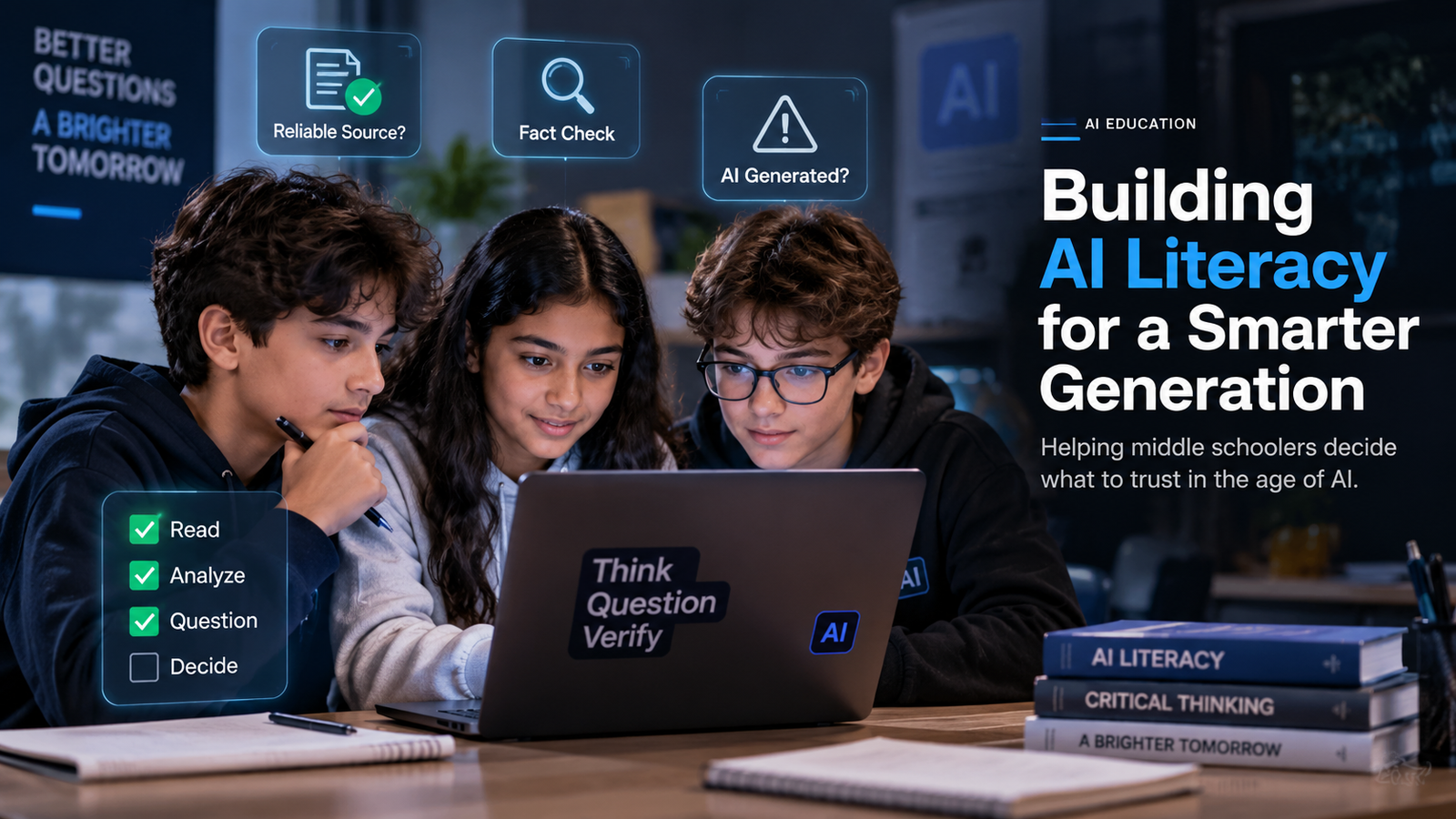
AI literacy is becoming an essential skill for middle school students as artificial intelligence becomes part of everyday learning and digital life.
As artificial intelligence becomes a bigger part of everyday life, knowing what information to trust is becoming an important skill — especially for younger users.
A new project backed by the U.S. National Science Foundation is looking to help middle school students develop that skill.
The University of Denver and The Tech Interactive have received a $50,000 planning award through the NSF FINDERS FOUNDRY program for a project focused on helping students independently evaluate AI-generated information.
The project focuses on AI literacy
Rather than simply teaching students to use AI tools, the project is focused on helping them think critically about the information those systems produce.
That distinction is becoming increasingly important as generative AI becomes easier for students to encounter at school, at home and through everyday digital services.
The project team plans to co-design a tool that reflects the ways students actually encounter AI-generated information in their daily lives.
The goal is to give students practical skills for questioning, evaluating and making decisions about AI-generated content instead of simply accepting an answer because it came from an AI system.
Why middle school students matter
Students are encountering AI at an increasingly young age, which means AI literacy cannot be limited to university students or working professionals.
For younger users, the challenge isn’t necessarily understanding how an AI model works internally. It’s learning how to recognize when an answer may need verification, when a source deserves more scrutiny and when an AI-generated response should not be treated as automatically reliable.
That makes critical evaluation an important part of responsible AI education.
A focus on confidence, not fear
The project also takes a different approach to AI education.
According to the project description, the aim is to build student agency rather than fear as young people grow up in an increasingly AI-driven environment.
That means the objective isn’t to tell students that AI is inherently unreliable or dangerous.
Instead, the project is intended to help students develop the confidence and skills needed to make their own judgments about AI-generated information.
Building on existing AI education work
The University of Denver and The Tech Interactive are also building on an existing collaboration.
Dr. Pilyoung Kim has previously worked with The Tech as an advisor and helped develop AI literacy lessons for the organization’s National AI Literacy Day activities.
The new NSF-backed planning project could therefore serve as a step toward developing more practical approaches to AI literacy for younger learners.
Why this matters as AI spreads
AI-generated information is increasingly appearing alongside traditional search results, educational resources, social media content and other digital experiences.
That makes AI literacy more than just a technical subject.
For students, understanding how to evaluate AI output could become a basic digital skill — similar to checking a source, comparing information and recognizing that confident-looking answers are not necessarily correct.
The NSF-backed project is still at the planning stage, so the eventual tool and its implementation will be important developments to watch.
For now, the project highlights a broader shift in AI education: teaching people not only how to use AI, but also how to think critically about what AI tells them.
Source: AI Understanding, based on reporting from Business Insiderhttps://aiunderstanding.org/news/new-nsf-backed-project-aims-to-help-middle-schoolers-decide-what-to-trust-in-the-a


Leave a Reply