
AI vs Human Intelligence: What’s the Difference and Who Is Smarter?
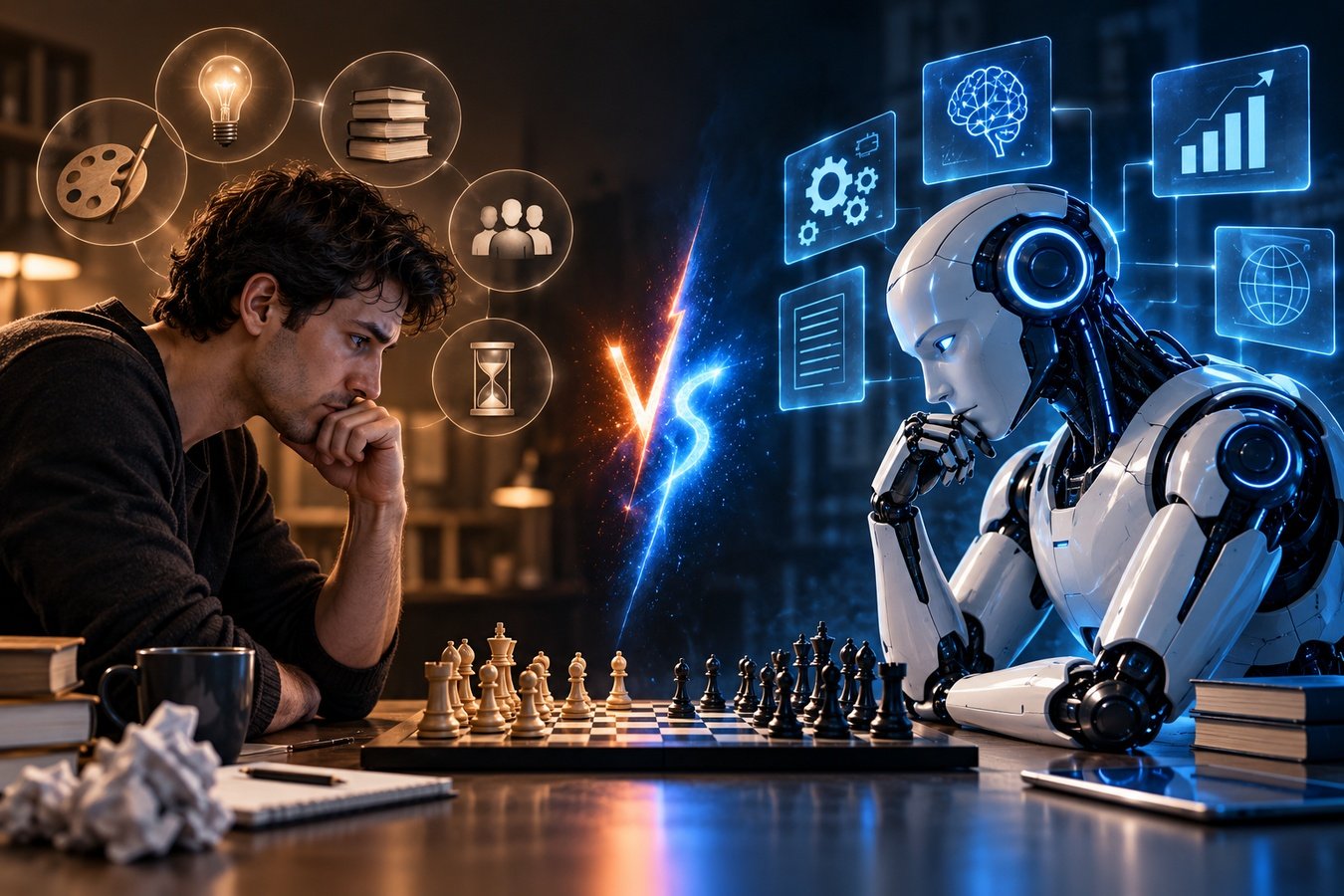
Artificial intelligence is becoming increasingly powerful, but does that mean machines are becoming smarter than humans?
The answer is more complicated than a simple AI vs human comparison.
Artificial intelligence can process enormous amounts of information, recognize patterns, automate repetitive tasks, generate content, and perform data-heavy work at remarkable speed. Human intelligence, however, brings something fundamentally different: emotions, creativity, empathy, ethical judgment, common sense, and lived experience.
The real future may not be about choosing between humans and AI. Instead, it may be about understanding how both can work together.
In this guide, we explore the key differences between artificial intelligence and human intelligence, what each does best, whether AI can replace humans, and what the future of human-AI collaboration could look like.
AI vs Human Intelligence: Quick Comparison
| Factor | Human Intelligence | Artificial Intelligence |
|---|---|---|
| Learning | Learns through experience, emotions, culture and social interaction | Learns from data, algorithms and feedback |
| Speed | Relatively slower at large-scale data processing | Extremely fast at data-heavy tasks |
| Creativity | Driven by imagination, emotions and lived experience | Generates outputs from learned patterns |
| Emotional intelligence | Understands and experiences emotions | Can detect emotional signals but does not experience emotions |
| Ethics | Can consider morality, values and consequences | Can recommend decisions but requires human oversight |
| Common sense | Uses real-world experience and context | Can struggle with unfamiliar or ambiguous situations |
| Scale | Limited by human time and attention | Can process huge datasets quickly |
| Adaptability | Highly flexible in unfamiliar situations | Usually performs best with defined tasks and suitable data |
The important point is that AI and human intelligence are not simply two versions of the same thing. They have different strengths and limitations.
What Is Human Intelligence?
Human intelligence is the natural ability to learn, understand, reason, solve problems, make decisions, and adapt to new situations.
But human intelligence goes beyond logical reasoning.
It includes:
- Creativity
- Emotional understanding
- Memory
- Language
- Curiosity
- Social awareness
- Empathy
- Moral judgment
- Contextual understanding
- Imagination
Humans can make decisions even when information is incomplete.
For example, a teacher may recognize that a student is struggling emotionally even when the student does not directly say it. A doctor may consider not only medical information but also a patient’s fears, circumstances, and personal needs.
This ability to understand context is one of the major differences between human and artificial intelligence.
What Is Artificial Intelligence?
Artificial intelligence is a branch of computer science focused on building systems capable of performing tasks that normally require aspects of human intelligence.
These tasks can include:
- Learning
- Reasoning
- Problem-solving
- Language understanding
- Image recognition
- Data analysis
- Decision support
- Content generation
- Pattern recognition
In simple terms, AI analyzes information and uses learned patterns to produce an output.
Modern AI systems can work with enormous datasets and perform certain tasks much faster than humans. They can summarize documents, translate languages, generate images, write code, detect anomalies, support customer service, and identify patterns in complex datasets.
AI vs Human Intelligence: Key Differences
1. Speed and Scale
One of AI’s biggest advantages is speed.
An AI system can analyze huge quantities of information far faster than a human working manually. This makes AI particularly useful for data-heavy tasks such as document analysis, fraud detection, demand prediction and pattern recognition.
Humans, however, are often better at determining which problem actually needs to be solved and why it matters.
2. Learning
Humans learn from much more than data.
People learn from:
- Experiences
- Emotions
- Culture
- Mistakes
- Relationships
- Stories
- Social feedback
AI systems generally depend on data, algorithms and feedback.
AI can become highly capable within a specific domain, but its performance depends heavily on the quality and relevance of the information and task it is given.
3. Creativity
AI can generate:
- Images
- Text
- Music
- Code
- Ideas
- Designs
But human creativity is influenced by personal experience, emotions, memories, culture, imagination and individual perspective.
This makes creativity another area where human intelligence remains fundamentally different from artificial intelligence.
4. Emotional Intelligence
Humans experience emotions.
This allows people to understand feelings, build relationships, show empathy and respond appropriately to complex social situations.
AI can analyze emotional signals in text, audio or other data, but it does not experience emotions in the same way humans do.
For example, an AI system may identify that someone’s message sounds negative, but a human can understand the deeper emotional context behind that person’s behavior.
5. Judgment and Ethics
AI can recommend decisions, but humans still need to determine whether those decisions are fair, safe, responsible and appropriate.
This distinction becomes especially important in areas such as:
- Healthcare
- Finance
- Education
- Hiring
- Law
- Public policy
AI may optimize for a particular outcome. Humans must still consider whether that outcome is ethically acceptable.
6. Common Sense
Common sense is another major difference.
Humans understand the world through physical experience, relationships, culture and everyday interactions.
AI can process enormous amounts of information, but it may still struggle with situations that require subtle real-world context.
Can AI Replace Humans?
AI can replace or automate some tasks, particularly repetitive and data-heavy work.
Examples include:
- Basic data entry
- Routine reporting
- Simple customer queries
- Scheduling
- Pattern-based analysis
- Repetitive administrative work
However, replacing individual tasks is different from replacing human intelligence entirely.
Many jobs contain a combination of automated and human tasks. AI may therefore change how people work rather than simply eliminate entire professions.
The World Economic Forum’s Future of Jobs Report 2025, cited by Simplilearn, projected both significant job creation and job displacement through 2030, highlighting the importance of job redesign and changing skill requirements.
AI and Humans Working Together
The most useful way to think about the future may not be AI versus humans, but AI plus humans.
AI can handle:
- Speed
- Scale
- Repetitive tasks
- Large datasets
- Pattern recognition
- Automation
Humans can provide:
- Direction
- Creativity
- Empathy
- Critical thinking
- Ethics
- Communication
- Final judgment
For example, AI can help a doctor identify potential risks in medical data, while the doctor explains the situation to the patient and makes the final decision.
Similarly, AI can analyze business data, while human leaders decide which strategy makes sense for customers, employees and the organization.
This combination of machine capability and human judgment could become one of the most important models of future work.
The Future of AI and Human Intelligence
The future is unlikely to be completely human-only or completely AI-only.
Instead, we are moving toward a hybrid model where humans and AI work together.
AI is likely to become increasingly common across:
- Businesses
- Healthcare
- Education
- Banking
- Creative industries
- Software development
- Customer service
Some jobs may change significantly, while new roles may emerge around AI development, automation, AI ethics, cybersecurity, data and related technologies.
At the same time, human skills such as communication, creativity, critical thinking, leadership and emotional intelligence will remain important.
The most valuable professionals may therefore be those who can combine AI skills with strong human skills.
AI vs Human Intelligence: Who Wins?
There is no simple winner.
AI is better at certain things:
Speed + Scale + Automation + Pattern Recognition + Data Processing
Humans are better at other things:
Empathy + Ethics + Creativity + Common Sense + Context + Emotional Understanding
The better question isn’t:
“Will AI become smarter than humans?”
A more useful question is:
“How can humans use AI without losing human judgment?”
The future of intelligence may not be about humans competing against machines. It may be about humans becoming better at working with machines.
Key Takeaways
- AI is extremely powerful at speed, scale, automation and data-heavy tasks.
- Human intelligence remains stronger in empathy, ethics, creativity, common sense and contextual understanding.
- AI can automate some tasks, but that does not mean it can completely replace human intelligence.
- The future of work is likely to involve greater collaboration between humans and AI.
- People who combine AI skills with communication, creativity and critical thinking may have an advantage in an AI-driven economy.